
A self-planned air-and-driver trip gives you day-by-day autonomy to shorten the holiday, skip corridors that hold less personal interest, or linger longer in a single valley. In exchange, that autonomy shifts every operational link onto your own shoulders: stitching together domestic flights across vast desert and mountain basins, re-checking full suitcases at regional airports, hiring reliable local vehicles across seasonal mountain highways, booking timed park entry slots, and absorbing schedule cascades when one domestic flight shifts.
The sections below compare the concrete logistical responsibilities of both travel models across the published 2027 route—without inventing hypothetical airfares, flight numbers, airline baggage tariffs or unverified DIY budgets—and set out a practical worksheet so you can verify dates, visa rules, route choices and written terms with Danny Dong Yi before committing a deposit.
Organized Rail Expedition vs. Self-Planned Air & Ground Trip
Xinjiang covers roughly one-sixth of China's land area—more than 1.6 million square kilometres divided by the Tianshan range into the Junggar Basin in the north and the Tarim Basin in the south. An itinerary that links northern alpine lakes and grasslands (Altay, Hemu, Kanas, Sayram Lake and the Ili river valley) with southern Silk Road oases and high plateaus (Kuqa, Kashgar, Taxkorgan on the Pamir Plateau and Korla) plus Qinghai's Chaerhan Salt Lake spans thousands of overland kilometres. Comparing one Guangzhou-to-Urumqi plane ticket against an 18-day rail loop misses most of the actual transport chain.
To evaluate both approaches fairly, compare who carries the operational responsibility across seven practical dimensions from departure morning in Guangzhou until the final return:
| Planning Dimension | Baiyun Express (18-Day Organized Rail) | Self-Planned Flights + Local Drivers |
|---|---|---|
| Corridor & Hub Structure | 18-day Guangzhou round trip via Chongqing, Hexi Corridor, Urumqi, North & South Xinjiang, Golmud and Chongqing | Separate flights from Guangzhou or Hong Kong to Urumqi, multiple intra-Xinjiang flights or long car transfers, and open-jaw return flights |
| Luggage Continuity | Leave primary luggage in your private train room during multi-night off-train hotel excursions; carry a compact overnight bag | Pack, weigh, check in and haul full suitcases through every regional airport terminal, security checkpoint, hotel lobby and car trunk |
| Ground Vehicles & Park Shuttles | Scheduled 2+1 land coaches, 7-seat business vans in Ili, and coordinated scenic-area shuttle transfers included per written itinerary | Contract separate licensed drivers in Altay, Ili, Kuqa and Kashgar; arrange park shuttles and one-way mountain drop-offs independently |
| Accommodation & Dining | Integrated Yunqi Lanyue (14 m²) or Yunqi Yayun (10.2 m²) cabin nights plus selected off-train hotels and scheduled onboard/local meals | Research, book and reconfirm 17 nights of hotels, breakfasts, highway lunches and dietary requests across eight or more towns |
| Altitude & Health Support | Multi-day overland progression before Kashgar and Pamir Plateau, supported aboard the train by the Yunhu · Anyu medical room and traveling doctor | Abrupt elevation changes if flying directly into high regional hubs; independent clinic lookup and transport coordination if unwell |
| Calendar & Pacing Control | Fixed 2027 calendar (3 dates currently on sale for individual bookings; 4 charter dates sold out) with structured group pacing and A/B/C route choices | Complete freedom to pick any departure day, shorten total duration to 8–12 days, or change daily plans on the spot |
| Commercial & Contract Clarity | Published per-guest reference fares (CNY 98,880–128,880, plus CNY 6,000 for Ili Route C) consolidated into one written quote and contract | Dynamic airfares, peak-summer grassland hotel surges, vehicle deadhead fees, fuel/tolls and attraction tickets paid across dozens of vendors |
Read the middle column as a summary of what Baiyun Express publishes for the 2027 18-day Guangzhou–Xinjiang programme, not as a substitute for your booking contract. Public pages establish the overall route structure, room categories, shared carriages and reference fares, while your dated written quotation and final departure notice govern the exact meeting address, baggage parameters, named hotels, route substitutions and included services for your chosen date.
Equally, read the right-hand column without assuming that self-planning is impossible. Experienced independent travellers with Mandarin fluency or dedicated local fixers complete flight-and-driver loops across Xinjiang every summer and autumn. The real question is whether you want to spend your pre-trip months and travel days managing multi-vendor logistics—or prefer to delegate corridor coordination so your energy goes into the landscapes and cultural stops themselves.
Party composition also changes how heavily each row weighs in practice. A solo traveller or agile couple carrying cabin-sized backpacks can pivot quickly if a regional flight out of Yining or Altay is retimed. By contrast, a multi-generational family coordinating four or six relatives, senior parents, prescription routines and full-size suitcases absorbs far steeper friction at every domestic airport counter and hotel check-in desk. Even on Baiyun Express, multi-room families should still ask in writing how adjacent cabins, combinable twin beds in Yunqi Yayun, and shared 7-seat vehicle assignments in Ili are handled rather than assuming automatic placement.
Mapping the 18-Day Corridor: Rail Continuity vs. Multi-Segment Air Hops
On a small-scale map, flying from southern China to Urumqi in roughly five hours appears to save two days each way compared with boarding a train in Guangzhou. When you trace all 18 days of the published Baiyun Express loop, however, you see that the train is not merely a shuttle between Guangzhou and Urumqi—it functions as a moving overnight base linking widely separated basins inside Xinjiang and Qinghai.
Breaking the published 18-day route into three geographical stages clarifies how the rail itinerary operates and what an equivalent flight-and-road plan must assemble by hand:
Stage 1: Guangzhou Departure, Chongqing & the Hexi Corridor (Days 1–4)
On Baiyun Express, Day 1 begins in Guangzhou with a station welcome ceremony and live onboard performances before the train travels overnight toward southwestern China. Day 2 pauses in Chongqing for guided visits to the Three Gorges Museum, a Chongqing mountain-city hotpot dinner, and evening views from the Raffles City crystal skybridge before re-boarding overnight. Day 3 is a daytime rail transit through the historic Hexi Corridor accompanied by onboard Silk Road cultural salons and Cantonese-Hunanese dining, arriving in Urumqi on Day 4.
If you fly independently from Guangzhou Baiyun International Airport (CAN) or Hong Kong International Airport (HKG) to Urumqi, you compress that outbound transit into one travel day—useful if your annual leave is tight. Yet international long-haul flyers still need an arrival buffer in southern China before any domestic connection or train boarding. Guests joining Baiyun Express from overseas can either book a flexible buffer night independently or pair their train ticket with the optional CTS 3-Day Guangzhou & Greater Bay Area Private Pre-Boarding Extension (published reference rate from CNY 9,800 per guest, covering VIP airport or cross-border Hong Kong arrival, two luxury hotel nights, Lingnan heritage visits and assisted station handoff).
Review the 3-day Guangzhou pre-boarding extensionStage 2: Northern Xinjiang & the Ili–Kuqa Mountain Crossings (Days 4–11)
Once in Xinjiang, the published programme lets guests customise two major regional branches without breaking away from the train's overnight backbone. On Days 4–7, North Xinjiang Route A visits the Xinjiang Regional Museum and Grand Bazaar in Urumqi, boards Baiyun Express overnight to Altay, drives the scenic Ahe Highway to Hemu Village, and continues by park shuttle to Kanas Lake (including a lake boat excursion and Three Bays walk) before re-boarding the train at Beitun for an overnight run to Yining. North Xinjiang Route B substitutes Tianshan Tianchi on Day 4, a Kazakh home banquet in Chonghuer Village on Day 5, and border-village views in Baihaba on Day 6 before rejoining the same Day 7 Kanas-to-Beitun rail link.
From Yining on Days 8–11, the programme switches to smaller 7-seat business vehicles suited to mountain highways across three selectable Ili–Kuqa branches. Route A circles Sayram Lake, visits Tianshan Flower Sea and Nalati Grassland, and crosses the Duku Highway southward to Bayinbuluk and Kuqa's Kiziliya Grand Canyon (subject to seasonal highway opening rules). Route B pairs Sayram Lake with Kalajun Grassland light trekking and Kurdening spruce valleys on May–August Tianshan Jinshu departures—or Tianshan Flower Sea and Nalati on the September 14 Jinfeng Huajuan departure—before returning to Yining to ride Baiyun Express overnight into Kuqa. Route C (carrying a published CNY 6,000 per-guest supplement) traverses the Yizhao Highway to Jade Lake for a chartered sunset boat dinner, explores Xiata Ancient Trail toward Muzart Glacier views, circles Sayram Lake, and takes the overnight train from Yining to Kuqa.
Replicating Days 4–11 independently by air and car is where DIY schedules encounter steep complexity. Regional flights between Urumqi, Altay/Kanas, Yining and Kuqa operate on thin seasonal timetables, often forcing connections back through Urumqi or multi-day highway drives. Moreover, famous seasonal roads such as the Ahe Highway, Duku Highway and Yizhao Highway enforce strict vehicle-seat limits (typically barring large buses) and weather or policy closures—something Baiyun Express explicitly notes in its itinerary rules and manages centrally when local authorities alter road access.
Explore the 2027 18-day route and A/B/C branchesStage 3: Kashgar, the Pamir Plateau, Korla & Golmud Return (Days 11–18)
On the evening of Day 11, all three Ili–Kuqa branches converge in Kuqa to board Baiyun Express overnight to Kashgar. Days 12–14 use 2+1 first-class land coaches along the China–Pakistan Friendship Highway (Karakoram Highway) onto the Pamir Plateau for White Sand Lake, Taxkorgan (including a Tajik family visit with eagle flute and dance heritage), and Karakul Lake beneath the snow peaks of Muztagh Ata and Kongur Tagh, followed by Kashgar Old City tea breaks and Id Kah Mosque before an overnight rail leg northeast to Korla.
Day 15 visits Bayingolin Museum and cruises Bosten Lake before the train climbs overnight onto the Qinghai-Tibet plateau margin at Golmud. Day 16 tours Chaerhan Salt Lake and the Ten-Thousand-Zhang Salt Bridge, after which Days 17 and 18 carry guests back via Chongqing to Guangzhou with onboard activities and dining. A self-planned air traveller covering Kashgar, Korla and Golmud faces scarce direct air links between southern Xinjiang and western Qinghai, usually requiring backtracking via Urumqi, Xi'an or Xining.
Luggage Continuity, Cabin Rest and Altitude Pacing
Over an 18-day loop spanning humid subtropics in Guangzhou, continental desert heat in Turpan/Kuqa/Kashgar, crisp alpine evenings in Hemu and Kanas, and cold high-elevation winds beside Karakul Lake on the Pamir Plateau, travellers must pack multiple clothing layers. How you move and store that wardrobe shapes daily physical fatigue.
Dual-Bag Train Living vs. Airport Check-In Fatigue
Baiyun Express is configured with 12 sleeping carriages accommodating a maximum of 92 guests across two en-suite twin categories: six 14 m² Yunqi Lanyue suites across two carriages (featuring twin beds, a two-seat sofa, minibar, private wardrobe and private bathroom) and forty 10.2 m² Yunqi Yayun rooms across ten carriages (featuring combinable twin beds, a folding sofa, storage and private bathroom). On overnight rail legs—such as Guangzhou to Chongqing, Chongqing to Urumqi, Urumqi to Altay, Beitun to Yining, Yining or Kuqa to Kashgar, Kashgar to Korla, Korla to Golmud, and Golmud back to Guangzhou—you sleep in your assigned private cabin rather than checking in and out of transit hotels.
When the itinerary moves into multi-night off-train hotel stays—such as Hemu and Kanas in northern Xinjiang, Sayram Lake / Nalati / Bayinbuluk / Kalajun / Zhaosu / Yining during the Ili branch, and Taxkorgan plus Kashgar in the south—guests pack a light 1-to-3-night bag for the road vehicles while primary cases remain stored securely in their train room. Contrast that rhythm with a five-flight DIY itinerary, where every regional flight requires repacking liquids and lithium power banks to strict civil-aviation security rules, lifting full suitcases onto terminal scanners, and unpacking from scratch across eight to ten separate hotels.
Keep one important evidence boundary in mind when planning bags: Baiyun Express's public website does not publish a universal luggage piece count, weight ceiling or centimetre dimension limit for the train cabins or road-transfer vehicles (2+1 coaches and 7-seat business vans). Do not assume either domestic airline allowances or standard high-speed rail baggage rules apply. Always ask Danny Dong Yi to confirm permitted bag counts, dimensions and handover procedures in writing for your chosen departure, especially if bringing bulky camera gear, mobility aids or medical equipment.
Compare Yunqi Lanyue (14 m²) and Yunqi Yayun (10.2 m²) cabinsOverland Altitude Pacing and Onboard Medical Support
Elevation management is a practical consideration on any journey reaching southern Xinjiang's Pamir Plateau (Days 12–13 around White Sand Lake, Taxkorgan and Karakul Lake) and western Qinghai's Golmud basin (Day 16). Flying directly from near-sea-level coastal cities into high-elevation plateau airports exposes travellers to rapid barometric shifts on Day 1. By contrast, the 18-day overland rail loop spends nearly eleven days moving gradually across moderate elevations in Chongqing, Urumqi, northern Xinjiang and the Ili–Kuqa corridor before ascending the Karakoram Highway from Kashgar toward Taxkorgan.
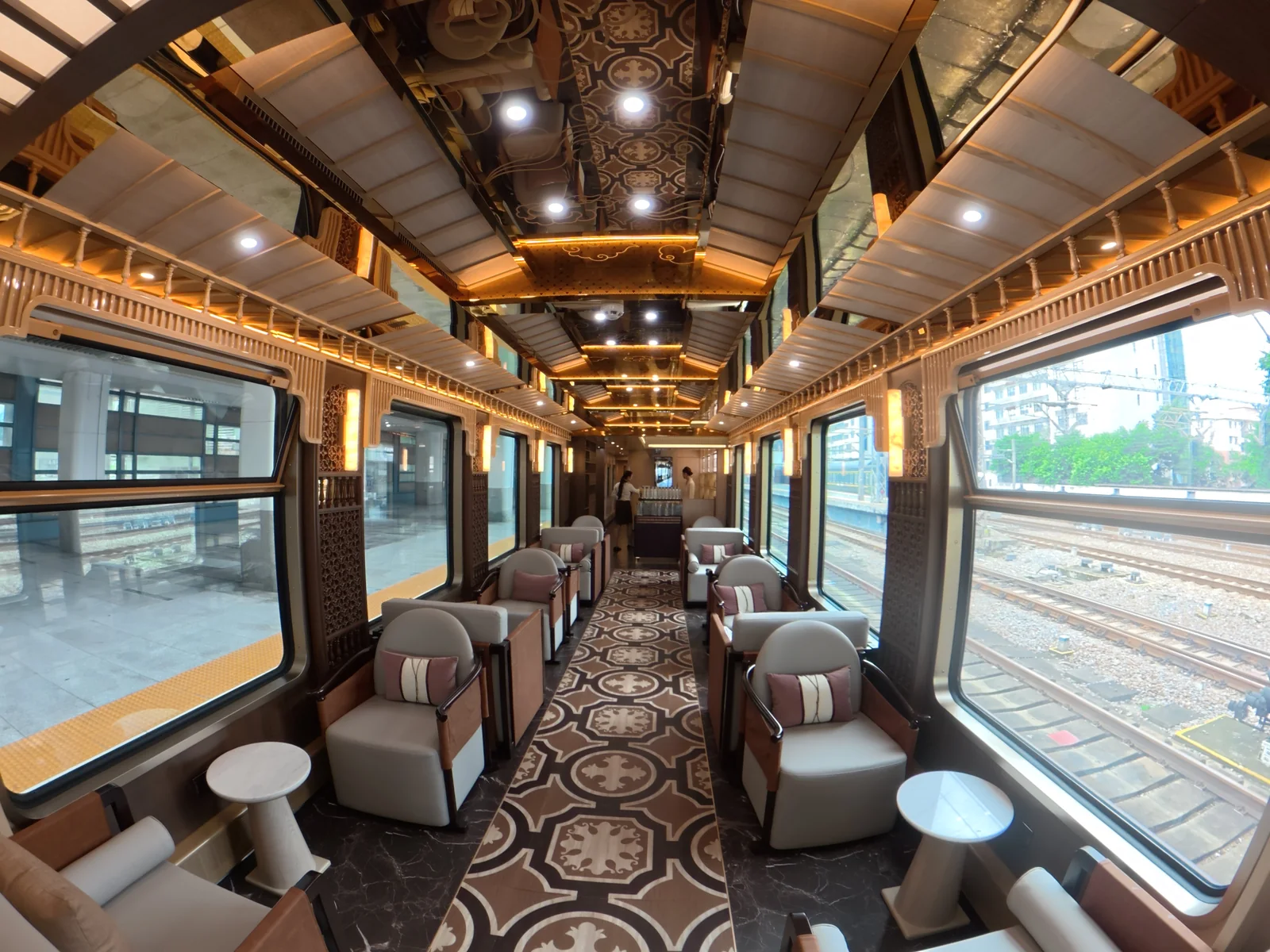
Aboard the train itself, Baiyun Express includes shared lounge carriages—Yunju · Xianting and Yunshang · Guanlan—where guests can stretch their legs and relax during transit hours, alongside Yunhu · Anyu, a dedicated onboard medical room staffed by an accompanying traveling doctor with basic medical supplies. Having a traveling doctor on the train adds reassuring first-line health consultation and routine monitoring across the 18-day loop.
Treat that medical support within strict clinical boundaries. Yunhu · Anyu is an onboard first-line consultation room, not an intensive-care hospital or an off-train ambulance following 7-seat vans across mountain passes, and gradual overland travel does not guarantee immunity against altitude illness. Travellers with cardiovascular, respiratory or chronic health conditions must obtain personal clearance from their own physician before booking, carry full courses of personal prescription medication in hand luggage, and confirm emergency hospital transfer procedures in writing.
Inspect shared lounges and the Yunhu · Anyu medical room2027 Calendar, Charter Status and Like-for-Like Cost Accounting
Schedule availability and budget structure often cast the deciding vote between booking Baiyun Express and designing a private flight-and-driver tour. Because Baiyun Express operates a finite annual calendar with just 92 guest berths per departure, checking live individual-booking status comes before any cost calculation.
For the 2027 18-day Guangzhou–Xinjiang programme, the official calendar lists seven departure dates split across two seasonal editions—six May-to-August dates under Tianshan Jinshu and one September date under Jinfeng Huajuan—with the following verified sales status:
Comparing June (Tianshan Jinshu) vs. September (Jinfeng Huajuan) Against Flight Seasons
Because only June 6, June 26 and September 14, 2027 remain open for individual bookings on Baiyun Express, your date choice also determines edition pricing and Ili Route B sightseeing. The June 6 and June 26 departures run under the Tianshan Jinshu edition (published reference fares CNY 98,880 in Yunqi Yayun and CNY 118,880 in Yunqi Lanyue), where Ili Route B features Kalajun Grassland light trekking, a grassland camp stay with an evening bonfire, and Kurdening's spruce-lined valleys. The September 14 departure runs under the Jinfeng Huajuan edition (CNY 108,880 in Yunqi Yayun and CNY 128,880 in Yunqi Lanyue), where Ili Route B shifts to Tianshan Flower Sea and Nalati Grassland.
Independent flyers encounter the exact same seasonal physics when pricing DIY trips. Early-to-late June brings long daylight hours across the Ili river valley and coincides with the typical seasonal opening window of mountain corridors, though high passes can still see sudden snow flurries or policy controls. Mid-September brings autumn colour windows in northern birch valleys alongside higher hotel and domestic flight demand across Kanas and Altay—one reason Baiyun Express's published September 14 reference fare sits CNY 10,000 per guest above the June departures.
How to Build an Honest Like-for-Like Cost Worksheet
A common budgeting mistake when comparing self-planned flights against Baiyun Express's CNY 98,880–128,880 per-guest reference fares is totalling only economy airfares and mid-range city hotels while omitting peak-season grassland lodging and private vehicle economics. We do not invent hypothetical airfare totals here because domestic air pricing, business-class cabin availability and seasonal hotel tariffs fluctuate week by week. Instead, build your own transparent side-by-side spreadsheet using actual quotes for your exact travel month.
On the self-planned side of your worksheet, include every component required to match the 18-day scope: (1) domestic flights linking Guangzhou, Chongqing, Urumqi, Altay/Kanas, Yining, Kuqa, Kashgar and Qinghai—priced in the cabin class and baggage tier you actually fly, plus airport transfers at both ends of every leg; (2) 17 nights of upper-upscale or luxury hotels, noting that June and September rates at flagship properties near Hemu, Kanas, Sayram Lake and Nalati are substantially higher than urban Urumqi hotels; (3) dedicated private 7-seat vans or 2+1 comfort vehicles across northern and southern Xinjiang, inclusive of fuel, expressway tolls, parking, driver daily allowances and empty-return deadhead days across one-way mountain corridors; (4) all scenic entry tickets, mandatory park shuttles, lake boat charters and museum admissions; (5) 17 breakfasts, 16–17 lunches and dinners including regional banquets; and (6) licensed English-speaking private guides in each region plus a financial contingency buffer for weather-delayed flights.
On the Baiyun Express side, remember that published website fares are dated reference figures rather than a live seat hold or binding invoice. Request a formal written quotation from Danny Dong Yi naming your exact 2027 date (June 6, June 26 or September 14), room category (Yunqi Yayun or Yunqi Lanyue), occupancy basis, North Route A or B, Ili–Kuqa Route A, B or C, exact inclusions and exclusions (such as inbound international flights, visa fees, personal insurance, Day 1 breakfast/lunch, or optional alcoholic beverages), payment schedule and cancellation terms.
Check live 2027 departure availability and request a written quote- Currently on sale for individual bookings (3 dates): June 6, 2027 (Tianshan Jinshu edition), June 26, 2027 (Tianshan Jinshu edition), and September 14, 2027 (Jinfeng Huajuan edition).
- Sold out — full-train government/private charter departures not open to individual bookings (4 dates): May 18, 2027, July 16, 2027, August 5, 2027, and August 24, 2027.
- Published May–August reference fares (applicable to June 6 and June 26, 2027 individual bookings): CNY 98,880 per guest in Yunqi Yayun (10.2 m² twin room) and CNY 118,880 per guest in Yunqi Lanyue (14 m² twin suite).
- Published September 14, 2027 reference fares (Jinfeng Huajuan edition): CNY 108,880 per guest in Yunqi Yayun and CNY 128,880 per guest in Yunqi Lanyue.
- Optional route and pre-train supplements: Ili–Kuqa Route C (Yizhao Highway, Jade Lake chartered sunset cruise & Xiata Ancient Trail) carries a published supplement of CNY 6,000 per guest; the optional CTS 3-Day Guangzhou & Greater Bay Area Private Pre-Boarding Extension starts from a published reference rate of CNY 9,800 per guest under a separate land quotation.
When a Self-Planned Flight Trip or Custom Private Tour Makes More Sense
Even when the operational convenience of an all-in-one luxury train is appealing, an 18-day fixed-departure rail loop is not the right instrument for every traveller, timeframe or passport scenario. Stepping back from the train—either to plan a focused flight-and-driver trip or to commission a custom private land-and-rail itinerary—is the smarter choice in four clear situations:
- Your calendar cannot match June 6, June 26 or September 14, 2027: Because May 18, July 16, August 5 and August 24, 2027 are sold out as government or private charters, travellers restricted to July, August, May or October school/work holidays will need an independent air itinerary or a custom-dated private tour.
- You have 7 to 12 days in China rather than 18+ days: Trying to squeeze both northern and southern Xinjiang into ten days is exhausting by any mode, whereas flying into Urumqi for an 8-day Kanas-and-Ili loop—or flying into Kashgar for a 7-day Silk Road and Pamir trip—delivers a rewarding regional trip within a shorter leave window.
- You plan to enter China solely under the 240-hour (10-day) visa-free transit policy: China's National Immigration Administration caps visa-free transit stays at 240 hours (10 days) within eligible regions and port rules. An 18-day Baiyun Express loop—typically 19 to 21 days in China once Guangzhou arrival buffers are added—exceeds 240 hours and requires either a valid Chinese visa or nationality-based 30-day visa-free eligibility.
- You prioritise unhurried solo photography, specialist trekking or zero daytime transit days: On Baiyun Express, Days 3 and 17 are full daytime rail transits across western corridors, and off-train sightseeing follows coordinated group timing. Dedicated landscape photographers waiting for golden-hour light at a single alpine bend, or families wanting spontaneous rest days on demand, gain real value from private flights and a dedicated vehicle.
Note that choosing against the fixed 18-day train calendar does not force you to handle Chinese domestic bookings alone. Through CTS.CN's international consultation desk on the booking page, Danny Dong Yi can advise whether one of the remaining open 2027 Baiyun Express departures fits your party—or whether a custom year-round private itinerary combining flights, high-speed rail and private chauffeur vehicles better matches your dates and pace.
Also keep Baiyun Express's product lines strictly separate when weighing shorter rail options: the 11-day Cloud Sanctuary journey (departing in late 2026 through Guangxi and Yunnan) and the tailored 9-day southern landscapes proposal are distinct Southwest China routes with separate calendars, fares and terrain—neither is a shortened version of the Xinjiang train.
Step-by-Step Worksheet: Compare Both Options Before Paying a Deposit
Before locking in non-refundable international flights to Guangzhou or Hong Kong—or purchasing domestic air segments into Urumqi—run through this eight-point verification checklist so both options are judged on confirmed facts rather than assumptions:
- Confirm calendar fit against open individual dates: verify that your party can board in Guangzhou on June 6, June 26 or September 14, 2027 (remembering May 18, July 16, August 5 and August 24 are charter sell-outs).
- Audit total stay length against China entry rules: calculate full China days including pre- and post-train buffers (19–22 days total) and confirm valid L-visa or 30-day visa-free passport eligibility rather than relying on 10-day transit rules.
- Select your preferred route combination: record North Xinjiang Route A (Ahe Highway, Hemu & Kanas boat) or Route B (Tianchi, Chonghuer & Baihaba), plus Ili–Kuqa Route A, Route B or Route C (+CNY 6,000 per guest).
- Price every equivalent DIY link if comparing costs: tally all domestic flights with checked baggage, 17 comparable peak-season hotel nights, licensed 7-seat mountain vehicles with deadhead fees, park shuttles, meals and private guiding.
- Plan your Guangzhou arrival buffer: allow at least one overnight buffer before reporting morning—or request a separate quote for the CTS 3-Day Guangzhou & Greater Bay Area Private Pre-Boarding Extension (from CNY 9,800 per guest).
- Document luggage, mobility and medical needs: send exact suitcase counts/dimensions, mobility-aid clearances or CPAP/medication power questions for written confirmation, and obtain personal physician clearance for the Pamir segment.
- Verify dietary or halal boundaries in writing: remember that typing a dietary note into an enquiry draft does not confirm supplier capability—request itemised written confirmation across onboard, hotel and off-train meals.
- Send your enquiry via official channels and review the written contract: check the live booking page (preparing a draft and sending via official WhatsApp or email while online submission is unavailable) and pay only against a dated written quote naming your room, route, inclusions and cancellation terms.
Pay equal attention to Day 18 return timing when comparing schedules. On the published Baiyun Express itinerary, Day 18 arrives back in Guangzhou from Chongqing with dinner governed by actual day-of train operations, and the public schedule does not guarantee a fixed arrival clock hour for onward international connections. Just as arriving at least a day early protects Day 1 boarding, holding an overnight hotel buffer in Guangzhou or Hong Kong on Day 18—or booking flexible onward flights the following day—prevents a railway dispatch delay on the final leg from jeopardising your flight home.
Keeping a dated copy of each written reply alongside your DIY comparison sheet ensures you never mix a general website description with a confirmed booking term—and lets every member of your travelling party weigh effort, comfort, flexibility and total cost on identical evidence. Re-verify live seat status on the booking page right before sending payment, as open individual berths across June 6, June 26 and September 14 can change without prior website notice.
Frequently Asked Questions: Train vs. Flying to Xinjiang
Is the 18-day Baiyun Express itinerary 100% on the train every night?
No. The published 18-day Guangzhou–Xinjiang programme combines overnight rail segments in your private Yunqi Lanyue or Yunqi Yayun cabin with scheduled off-train hotel stays in key destinations—including Hemu, Kanas, the Ili corridor (such as Sayram Lake, Nalati, Bayinbuluk, Kalajun camp, Zhaosu or Yining depending on whether you select Route A, B or C), Taxkorgan and Kashgar. During off-train hotel nights, guests carry a compact overnight bag while main suitcases stay aboard the train.
Which 2027 Baiyun Express Xinjiang departures are still open for individual bookings?
Out of the seven published 2027 Xinjiang calendar dates, three are currently on sale for individual bookings: June 6, 2027 and June 26, 2027 (Tianshan Jinshu edition, reference fares CNY 98,880 in Yunqi Yayun / CNY 118,880 in Yunqi Lanyue) and September 14, 2027 (Jinfeng Huajuan edition, reference fares CNY 108,880 in Yunqi Yayun / CNY 128,880 in Yunqi Lanyue). The May 18, July 16, August 5 and August 24, 2027 departures are sold out as government or private charters and are not available for individual sale.
Can international travellers join in Urumqi or leave the train early in Kashgar instead of riding round trip from Guangzhou?
The published 2027 Xinjiang product is structured and priced as an 18-day Guangzhou-to-Guangzhou round trip. Do not book flights into Urumqi or out of Kashgar assuming mid-route boarding or early disembarkation is permitted; any non-standard joining or leaving request must be raised before payment and is valid only if explicitly accepted in your dated written booking confirmation.
Can I use China's 240-hour visa-free transit policy for the 18-day Baiyun Express loop vs. a shorter flight trip?
Not for the 18-day Baiyun Express loop. China's National Immigration Administration limits visa-free transit stays to a maximum of 240 hours (10 days) within approved stay areas, whereas an 18-day round trip plus Guangzhou arrival buffers spans roughly 19 to 21 days and crosses multiple western provinces. Verify whether your passport qualifies for a 30-day unilateral or bilateral visa-free stay, or apply for an appropriate Chinese visa before booking.
Does Baiyun Express publish a strict luggage weight limit like domestic airlines?
Unlike domestic airlines that publish fixed kilogram and piece tariffs by fare class, Baiyun Express's public website does not publish a universal baggage weight, piece or dimension limit for its private cabins or road-transfer vehicles. Because space inside 10.2 m² and 14 m² cabins as well as 7-seat Ili vehicles is finite, confirm permitted bag counts, sizes and handover rules in writing with Danny Dong Yi before departure.
What if my 2027 travel window does not match June 6, June 26 or September 14?
If your available travel dates fall on a charter-booked month such as July or August, or if you only have 8 to 12 days available, contact Danny Dong Yi via the official booking consultation channels. Alongside Baiyun Express train reservations, CTS.CN can quote private custom itineraries combining domestic flights, high-speed rail and dedicated local vehicles tailored to your exact travel window.
How are halal or allergen-specific meals handled on the train compared with a self-planned air trip?
On a self-planned air-and-driver trip, you choose every restaurant yourself—convenient in major halal dining hubs like Urumqi and Kashgar, but harder to verify at remote highway stops or non-halal resort hotels. On Baiyun Express, the published itinerary combines onboard Cantonese and Hunanese dining prepared in the Yunchu · Yushan kitchen car with regional off-train meals (such as Chongqing hotpot, Burqin cold-water fish, Sayram whitefish, Taxkorgan yak hotpot, Kashgar roast whole lamb and a Golmud halal wellness meal). However, menu labels and enquiry-form requests do not establish verified supplier-by-supplier halal certification or allergen isolation; always obtain itemised written confirmation for every onboard, hotel, off-train and packed meal before paying a deposit.