
By contrast, the reviewed New Orient Express sales catalog lists a 14-day Snow Lotus itinerary starting and ending in Urumqi, while showing an internal price conflict on its June 2, 2027 catalog page between header figures (CNY 58,999 and CNY 65,999) and schedule-table figures (CNY 62,999 and CNY 68,999). Because one programme includes cross-country rail transit from southern China's primary international air and high-speed rail hub while the other requires separate domestic flights into and out of Xinjiang, raw headline prices do not measure equivalent scope.
This comparison examines only verifiable published specifications from Baiyun Express's official itinerary, cabin, carriage and booking pages alongside the reviewed Snow Lotus catalog entry. Use the side-by-side matrices, gateway logistics analysis and contract verification checklist below to build an accurate door-to-door quotation before committing a deposit to either train.
Published 2027 Product Specifications Side by Side
Comparing luxury tourist trains in China starts with aligning product boundaries rather than dividing a brochure figure by the number of days. When trip length differs by four days, starting cities sit more than three thousand kilometres apart, and cabin occupancy or en-suite bathroom rules vary by carriage class, only a structured attribute-by-attribute check reveals what your fare actually covers.
Use the specification table below to separate confirmed public data on Baiyun Express's official site from the reviewed June 2, 2027 New Orient Express Snow Lotus catalog sample, and note where written seller confirmation is required before treating any figure as bookable.
| Comparison Dimension | Baiyun Express (Official Published Data) | New Orient Express · Snow Lotus (Reviewed Catalog) |
|---|---|---|
| Starting & Ending Hub | Guangzhou direct round trip (outbound via Chongqing & Hexi Corridor; return via Korla, Golmud & Chongqing) | Urumqi round trip (requires separate domestic air or rail tickets into and out of Xinjiang) |
| Published Duration | 18 days / 17 nights | 14 days (regional Xinjiang loop) |
| Train Formation & Guest Cap | 18 carriages · strict 92-guest capacity (6 Yunqi Lanyue suites + 40 Yunqi Yayun rooms) | Varies by departure rake; request exact carriage formation and total passenger cap in writing |
| Cabin Area & Bathroom Setup | Yunqi Lanyue (14 m²) & Yunqi Yayun (10.2 m²); both private twin categories with private en-suite bathroom | Multiple cabin tiers vary by train set; verify cabin square metres and private vs. shared carriage-end bathrooms |
| 2027 Calendar & Sales Status | 7 published dates: Jun 6, Jun 26 (Tianshan Jinshu) & Sep 14 (Jinfeng Huajuan) currently on sale; May 18, Jul 16, Aug 5 & Aug 24 sold out (government/private charters) | Catalog sample lists 2027 dates including June 2, 2027; verify live charter allocation with selling agency |
| Published Reference Fares | May–Aug: Yayun CNY 98,880 / Lanyue CNY 118,880 per guest; Sep 14: Yayun CNY 108,880 / Lanyue CNY 128,880; Ili–Kuqa Route C +CNY 6,000 | June 2, 2027 catalog page displays internal conflict: CNY 58,999 / 65,999 in header vs. CNY 62,999 / 68,999 in schedule table |
| Route Customisation | Selectable North Xinjiang (Route A or B) and Ili–Kuqa (Route A, B or C) branches combined with shared Pamir & Salt Lake arc | Fixed 14-day regional Urumqi sequence presented in reviewed catalog sample |
| Ground Vehicles & Governance | 2+1 premium coaches, Kanas shuttles & 7-seat MPVs in Ili; operated by Panda Roam with CTS.CN strategic partnership | Ground coach type, off-train hotel list and contracting agency depend on the specific charter reseller |
Two commercial facts stand out immediately in this 2027 comparison. First, on Baiyun Express's published seven-date 2027 calendar, individual international and domestic guests can currently book three open departures: June 6, 2027 and June 26, 2027 under the Tianshan Jinshu edition, plus September 14, 2027 under the Jinfeng Huajuan edition. The remaining four listed calendar dates (May 18, July 16, August 5 and August 24, 2027) are officially marked sold out because they are contracted as government or private charter departures and are not open to individual bookings.
Second, the reviewed New Orient Express Snow Lotus catalog page for June 2, 2027 contains a direct internal pricing discrepancy on the same sheet: the banner header quotes CNY 58,999 and CNY 65,999 per person, whereas the dated schedule table directly underneath quotes CNY 62,999 and CNY 68,999 for the exact same categories. Because a CNY 3,000 to CNY 4,000 per-guest difference appears inside one sales document, neither pair of numbers functions as a verified final price until a selling agency issues a dated written quotation tied to a named cabin category.
Keep reference status clear on both sides as well. Baiyun Express's published website fares (CNY 98,880 to CNY 128,880 per guest, plus CNY 6,000 if selecting Ili–Kuqa Route C) are official reference figures rather than live seat holds or signed contracts. Availability, final fare, cabin assignment, route selections and payment schedules become binding only when confirmed in writing on your booking quotation and contract.
Guangzhou Direct Round Trip vs. Urumqi Regional Staging
For overseas travellers flying from Singapore, Kuala Lumpur, Sydney, Melbourne, London, Paris, Vancouver or Los Angeles, as well as residents of Hong Kong and Macau, the train's starting hub determines how many separate transport tickets, baggage transfers and buffer nights you manage on your own. Baiyun Express starts and finishes in Guangzhou, capital of Guangdong Province and anchor of the Greater Bay Area.
Guangzhou Baiyun International Airport (CAN) operates extensive non-stop intercontinental and Asian regional routes, while Hong Kong International Airport (HKG) connects to Guangzhou via high-speed rail from Hong Kong West Kowloon Station or private cross-border MPV transfers. Boarding your luxury train in Guangzhou and stepping off in Guangzhou on Day 18 keeps your entire China overland journey inside one continuous operational loop.
Staging an Urumqi-originating 14-day itinerary works differently for overseas flyers. Because few long-haul flights outside Central and West Asia land non-stop at Urumqi Diwopu International Airport (URC) on daily schedules convenient for tour group reporting times, most international guests booking an Urumqi round-trip train must purchase separate domestic round-trip flights via hubs such as Beijing, Shanghai, Chengdu, Xi'an or Guangzhou.
Adding separate domestic flights introduces four practical friction points that rarely appear in a train brochure:
Pairing Guangzhou boarding with a structured 3-day Greater Bay Area buffer
Travellers who want time-zone recovery and Cantonese cultural depth before their 18-day Xinjiang rail expedition can attach CTS's optional 3-day Guangzhou and Greater Bay Area private pre-boarding extension (published indicative reference rate from CNY 9,800 per guest on a twin-share basis, quoted separately from the train fare). Across three days and two five-star Guangzhou hotel nights, a dedicated bilingual concierge meets your flight at Guangzhou (CAN) or coordinates cross-border arrival from Hong Kong (HKG), guides private visits to Shamian Island and Chen Clan Ancestral Hall with curated Cantonese dining, and escorts your tagged luggage directly to the Baiyun Express station reporting point on boarding morning.
An Urumqi-only train still makes practical sense in specific cases: if you are already travelling overland through Gansu or Qinghai, flying in directly from a Central Asian hub with convenient Urumqi schedules, or strictly constrained to two calendar weeks of annual leave. Weigh your real flight routing from home before deciding which hub requires less effort.
Review the 3-Day Guangzhou & Greater Bay pre-boarding extension- Split-ticket delay risk: When your domestic flight to Urumqi is ticketed separately from the tourist train charter, a weather or air-traffic delay on arrival day remains your responsibility; prudent travellers arrive in Urumqi at least one full night, and often two nights, before Day 1 train check-in.
- Domestic baggage re-checking and weight rules: Transferring from an international wide-body flight onto a domestic Chinese narrow-body sector frequently requires reclaiming suitcases at your port of entry, clearing customs, re-checking bags, and complying with domestic economy or business cabin weight limits that may be stricter than long-haul allowances.
- Extra hotel check-ins at both ends: A 14-day Urumqi rail tour typically requires a pre-train hotel night in Urumqi before departure and a post-train hotel night in Urumqi if the train returns late in the afternoon or evening after outbound flights to eastern China hubs have departed.
- Unbundled airport transfers and English support: Unless you purchase a custom private land wrapper around your Urumqi train ticket, navigating Urumqi airport arrivals, hotel taxis and station drop-offs falls outside the rail package.
What the Four Extra Days Cover: Route Architecture, Editions and Selectable Branches
A common misconception when comparing an 18-day Guangzhou–Xinjiang train with a 14-day Urumqi loop is assuming the four-day difference consists purely of featureless transit tracks. Inspecting Baiyun Express's published day-by-day 2027 itinerary shows that the cross-country corridor integrates major cultural and geological stops on both the outbound and return arcs while positioning guests into Xinjiang without airport fatigue.
On Day 1, guests board in Guangzhou for a platform welcome ceremony and live musical performances as the train travels overnight to Chongqing. Day 2 disembarks in Chongqing to visit the Three Gorges Museum, dine on authentic Chongqing mountain-city hotpot, and ascend the Raffles City crystal skybridge viewing deck for night views over the Yangtze and Jialing confluence before re-boarding toward northwest China. Day 3 crosses the historic Hexi Corridor with onboard Silk Road cultural salons and panoramic dining.
Once inside Xinjiang on Day 4, Baiyun Express replaces a rigid single-track group schedule with modular route customization. Guests select their departure edition (Tianshan Jinshu for June 6 and June 26 on-sale dates; Jinfeng Huajuan for the September 14 on-sale date), then choose one Northern Xinjiang branch (Days 4 to 6) and one Ili–Kuqa branch (Days 8 to 11), subject to the rule that options within the same section cannot be mixed:
Southern Xinjiang, the Pamir Plateau and the Qinghai return arc (Days 12 to 18)
After Kuqa on Day 11, every Baiyun Express guest continues overnight by rail to Kashgar for a full Southern Xinjiang and Pamir Plateau sequence. Day 12 ascends the China–Pakistan Friendship Highway (Karakoram Highway) onto the Pamir Plateau to visit Baisha Lake and Taxkorgan, including a Tajik family visit featuring traditional eagle-flute music and dance plus a yak-beef hotpot dinner. Day 13 visits Karakul Lake beneath the glaciated peaks of the Kunlun Mountains before returning to Kashgar for a roast whole lamb banquet, followed on Day 14 by Kashgar Old City with an exclusive tea break and Id Kah Mosque before boarding the night train to Korla.
Rather than flying abruptly out of Kashgar or backtracking empty to Urumqi, Days 15 to 18 turn the eastward return into a multi-province finale: Day 15 visits Bayingolin Museum and takes a boat excursion on Bosten Lake in Korla; Day 16 stops in Golmud, Qinghai to walk Chaerhan Salt Lake and the Ten-Thousand-Zhang Salt Bridge; and Days 17 and 18 travel via Chongqing back into Guangzhou.
In the reviewed Snow Lotus catalog sample, the 14-day Urumqi round trip follows a single fixed regional route without selectable A/B/C sub-branches or the Chongqing and Chaerhan Salt Lake rail corridors. When comparing any Snow Lotus departure sheet, check whether its 14 days cover both Altay/Kanas in the north and Taxkorgan/Pamir in the south, and calculate how many hours are spent on long highway transfers if rail segments are shorter.
Explore all 2027 Baiyun Express Xinjiang editions and route branches- Northern Xinjiang · Route A (Ahe Scenic Road & Kanas cruise): Visits the Xinjiang Uygur Autonomous Region Museum and International Grand Bazaar in Urumqi on Day 4, drives the scenic Ahe Highway from Altay to Hemu Village on Day 5 (with weather or road-control routing fallbacks noted), and pairs Hemu Tuva wooden-cabin valley views and private tea service with a Kanas Lake boat cruise on Day 6.
- Northern Xinjiang · Route B (Tianshan Tianchi & border villages): Visits Tianshan Tianchi alpine lake beneath Bogda Peak on Day 4, travels to Chonghuer Village for traditional Kazakh performances and a Kazakh home banquet before reaching Hemu on Day 5, and follows the Tiejia road to the border village of Baihaba before continuing into Kanas on Day 6.
- Shared Day 7 · Kanas Three Bays to Beitun: Both Northern Xinjiang branches reunite to tour Shenxian Bay, Moon Bay and Wolong Bay inside Kanas, pause in Burqin for an intangible-heritage cold-water fish banquet, and board Baiyun Express overnight toward Yining.
- Ili–Kuqa · Route A (Sayram Lake, Nalati & Duku Highway crossing): Circles Sayram Lake on Day 8, visits Tianshan Flower Sea and Nalati Grassland on Day 9, crosses the northern-to-central Duku Highway from Nalati to Bayin on Day 10, and traverses the southern Duku Highway into Kuqa for Kiziliya Grand Canyon on Day 11 (open only when seasonal weather and local highway policies permit).
- Ili–Kuqa · Route B (Grassland immersion, edition-dependent): On Tianshan Jinshu departures (including the open June 6 and June 26 dates), Day 8 circles Sayram Lake, Day 9 features a light grassland walk, herding experience, camp stay and evening bonfire at Kalajun Grassland, and Day 10 walks spruce-lined streams at Kurdening before taking the train from Yining to Kuqa. On the September 14 Jinfeng Huajuan departure, Route B visits Sayram Lake on Day 8 and Tianshan Flower Sea plus Nalati on Days 9 and 10 before rejoining the train in Yining for Kuqa.
- Ili–Kuqa · Route C (Private Yizhao & Xiata journey, +CNY 6,000 per guest): Follows the scenic Yizhao Highway to Jade Lake for an exclusive chartered sunset dinner cruise on Day 8, explores Xiata Ancient Trail with distant views toward Muzart Glacier on Day 9 before staying in Yining, circles Sayram Lake on Day 10, and visits Kuqa's Kiziliya Grand Canyon on Day 11.
92-Guest Train Density, Private En-Suite Cabins and Shared Carriages
On an 11-to-18-day rail journey where you sleep aboard the train for more than half the trip, two numbers govern everyday comfort more than exterior livery: maximum guest headcount across the whole train and whether every sleeping compartment contains its own private bathroom. Baiyun Express publishes exact formation figures across 18 carriages with a strict ceiling of 92 passengers.
Those 92 berths divide cleanly across twelve sleeping carriages in two twin-occupancy categories, and every published cabin category includes a private en-suite bathroom:
How a 92-guest ceiling shapes dining, lounge and medical spaces
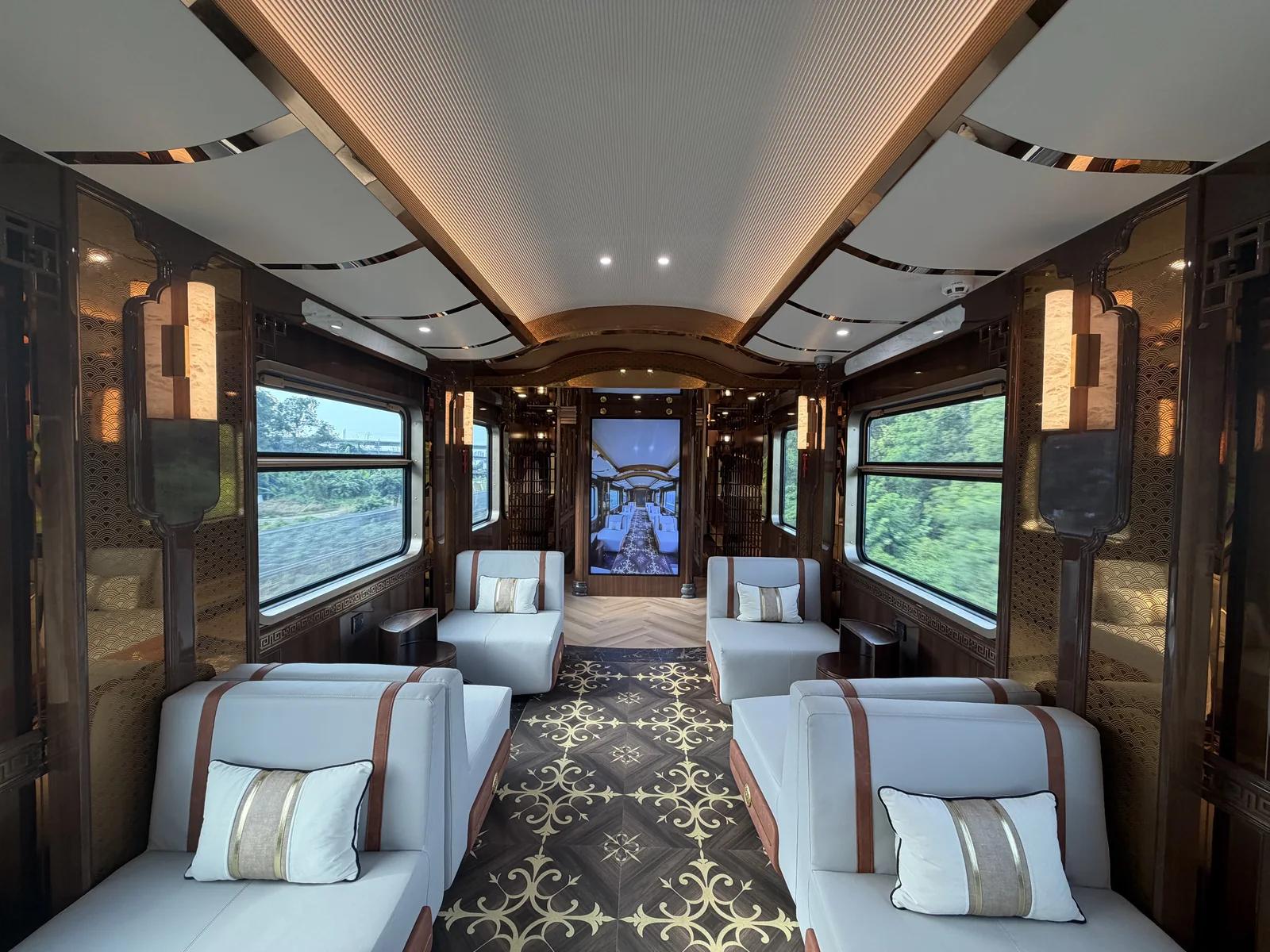
Six dedicated functional and support carriages serve those 92 travellers. Yunju Xianting acts as a four-door welcome and salon carriage featuring a ceremonial entrance, Lingnan-and-Huxiang gallery corridor, tea bar and performance stage. Yunyan Qinghuan, the Chinese banquet dining carriage, provides 48 window-side seats plus a buffet counter and walk-in washroom area, meaning the entire 92-guest manifest dines comfortably across two unhurried seatings or staggered service rather than rushing through three or four tight meal waves.
At the tail of the formation, Yunshang Guanlan serves as the panoramic observation carriage, combining window lounges, a beverage bar, an Aiwan Pavilion and red-maple cultural focal installation, and two enclosed mahjong and card rooms. A dedicated kitchen carriage, a smart butler call system, senior-friendly interior hardware, and the Yunhu Anyu medical carriage (supported by an accompanying doctor, train butler team, photographer and tour leader) complete the onboard operation.
Translate the 3.8 m² published area gap between Yunqi Lanyue (14 m² across carriages 7 and 11 on the three-suite floorplan) and Yunqi Yayun (10.2 m² across ten four-room carriages) into concrete ergonomic questions before booking either train. A floor-area total alone does not specify doorway widths, shower threshold height, bedside outlet positions for medical devices such as CPAP machines, or under-bed suitcase clearance. If you require combinable twin beds (explicitly listed for Yayun), cabin placement close to the dining car, or specific storage space for camera and cold-weather gear, ask for written confirmation tied to your assigned cabin category.
View Baiyun Express welcome, dining, observation and medical carriagesApplying strict cabin and photo verification to both trains
Treat visual evidence carefully when comparing luxury trains. On Baiyun Express's English rooms page, interior cabin views for Lanyue and Yayun are transparently labelled as design renderings, while archived real-world photographs from the August 2026 launch collection appear in the official gallery (documenting Lanyue bedroom and bathroom spaces, Yayun bedrooms, and shared welcome and observation carriages, while explicitly noting that no confirmed real photograph of Yayun's en-suite bathroom is included in the archive).
Apply the exact same verification standard when evaluating New Orient Express Snow Lotus or any other western China tourist train. Under the broader New Orient Express banner, different train sets and ticket tiers vary widely in carriage occupancy and washroom access: some higher tiers provide private en-suite wet rooms, whereas standard four-berth or two-berth compartments on certain formations share washrooms and showers at carriage ends. Ask the Snow Lotus seller in writing for four facts tied to your exact departure date: total passenger capacity across the whole train, exact floor area in square metres for your named cabin tier, written confirmation of a private in-cabin shower and toilet versus shared carriage facilities, and whether brochure photos depict the actual Snow Lotus rake operating that departure.
Compare Yunqi Lanyue (14 m²) and Yunqi Yayun (10.2 m²) specifications- Yunqi Lanyue (14 m² twin suite): Six suites distributed across two three-suite carriages (three suites per carriage, serving 12 guests total). Published specifications separate sleeping, living, storage and bathing zones, equipping each suite with twin beds, a two-seat sofa, a minibar, a private wardrobe and a private en-suite bathroom.
- Yunqi Yayun (10.2 m² twin room): Forty rooms distributed across ten four-room carriages (four rooms per carriage, serving 80 guests total). Published specifications include combinable twin beds, a folding sofa, dedicated storage and a private en-suite bathroom, styled in emerald-green or warm ink-walnut schemes.
Ground Vehicles, Off-Train Hotels and Dietary Verification
Neither Xinjiang tourist train stays coupled to the rails 24 hours a day. Alpine lakes, grassland valleys and high-mountain passes such as Kanas, Hemu, Sayram Lake, Nalati, the Duku Highway, the Yizhao Highway and Taxkorgan sit miles from railway tracks, making ground vehicles and off-train hotels decisive parts of the product.
Baiyun Express's 2027 itinerary publishes explicit vehicle types and named reference hotels for every off-train stage rather than leaving ground transport vague. On shared urban and plateau corridors (Chongqing, Urumqi, Altay to Hemu, Kashgar to Taxkorgan and Karakul Lake, Korla, and Golmud), guests travel in 2+1 first-class land coaches (three wide seats per row instead of standard four-abreast tour buses), paired with official scenic-area shuttles inside Kanas.
Across all three Ili–Kuqa branches (Days 8 to 11 on Routes A, B and C), Baiyun Express switches guests into 7-seat business MPVs. That vehicle specification matters operationally: famous mountain corridors such as the Duku Highway and Yizhao Highway enforce strict axle and passenger-seat limits that prohibit full-size coaches, so pre-planned 7-seat MPVs enable direct scenic traversal without last-minute bus substitutions.
Off-train hotel nights are similarly itemised by reference property or equivalent tier on Baiyun Express's published schedule: Holiday Inn Hemu and high-end Kanas scenic lodges in the north; Hotel Indigo Sayram Lake, Hotel Indigo Nalati, Holiday Inn Bayinbuluk, Kalajun luxury grassland camps, Zhaosu Muzitao wilderness resort or InterContinental Yining depending on your Ili branch; and Crown / Wanda Moments in Taxkorgan plus Global Harbor / Radisson in Kashgar.
Altitude and onboard medical readiness also deserve side-by-side comparison. Baiyun Express's shared Days 12 and 13 ascend the Karakoram Highway to Baisha Lake, Taxkorgan and Karakul Lake on the Pamir Plateau before crossing Qinghai's Chaerhan Salt Lake in Golmud on Day 16, backed throughout rail segments by the Yunhu Anyu medical carriage and an accompanying doctor. When reviewing a 14-day Snow Lotus schedule, verify which high-elevation passes or Pamir stops appear on your departure sheet, consult your personal physician with the exact overnight altitudes, and confirm in writing whether a licensed medical professional travels aboard that specific Snow Lotus formation.
When reviewing a Snow Lotus quotation alongside Baiyun Express, audit four ground-service details line by line:
- Ground coach configuration: Confirm whether long Xinjiang highway legs use standard 2+2 coaches, 2+1 wide-seat coaches, or 7-seat MPVs on mountain pass routes.
- Off-train hotel nights and property names: Count how many nights are spent in hotels versus onboard sleepers, and check whether reference hotel names and locations (inside vs. outside Kanas or Hemu scenic gates) are specified in writing.
- Tickets, shuttles and chartered experiences: Check whether national-park entry fees, Kanas shuttles, lake cruises (such as Kanas Lake, Bosten Lake, or Route C's private Jade Lake sunset boat) and museum guides are bundled or billed locally.
- Meals and strict dietary boundaries: Baiyun Express alternates onboard Cantonese–Hunanese (Yuexiang Zhiwei) dining with regional specialty feasts such as Chongqing hotpot, Burqin cold-water fish, Kazakh home banquets, Sayram coregonus, Taxkorgan yak hotpot, Kashgar roast lamb and Golmud halal wellness cuisine. On either train, remember that noting 'halal' or a food allergy on an enquiry form does not prove certified halal slaughter, separate cookware or allergen-free hotel kitchens; obtain written confirmation of what each kitchen can and cannot verify before booking.
How to Build an Apples-to-Apples 2027 Budget Worksheet
A side-by-side price comparison only works when both columns measure the same travel calendar, availability status and door-to-door out-of-pocket expenses. Start by filtering out unavailable dates: on Baiyun Express's 2027 Xinjiang calendar, May 18, July 16, August 5 and August 24 are closed to individual travellers as government or private charters. Individual fare planning therefore focuses on the three active on-sale departures: June 6 and June 26, 2027 (Tianshan Jinshu edition: Yunqi Yayun CNY 98,880 per guest; Yunqi Lanyue CNY 118,880 per guest) and September 14, 2027 (Jinfeng Huajuan edition: Yunqi Yayun CNY 108,880 per guest; Yunqi Lanyue CNY 128,880 per guest), plus CNY 6,000 per guest only if you choose Ili–Kuqa Route C.
Next, resolve the internal catalog conflict on the competing quote. On the reviewed June 2, 2027 Snow Lotus catalog sheet (which sits just four days ahead of Baiyun Express's open June 6, 2027 departure), the page header lists CNY 58,999 and CNY 65,999 while the schedule table below lists CNY 62,999 and CNY 68,999. In multi-agent rail charter distribution, discrepancies like this arise when header graphics retain an earlier wholesale tier while the schedule grid reflects updated peak-season or allotment pricing. Never average conflicting brochure numbers or assume the lower banner figure wins; ask the selling agency to confirm the active contracted fare in writing.
Once you hold dated written cabin fares for both trains, complete the seven-line worksheet below for your entire party so unbundled air, hotel and extra-day expenses become visible before you decide:
| Cost Component | Baiyun Express 18-Day (Guangzhou Hub) | New Orient Express Snow Lotus 14-Day (Urumqi Hub) |
|---|---|---|
| 1. Base Train Package Fare | On-sale Jun 6 / Jun 26: CNY 98,880 (Yayun) or CNY 118,880 (Lanyue); Sep 14: CNY 108,880 or CNY 128,880 per guest | Resolve June 2 conflict in writing (header CNY 58,999 / 65,999 vs. table CNY 62,999 / 68,999) for exact cabin tier |
| 2. Optional Route / Tier Upgrades | CNY 0 for Routes A or B; +CNY 6,000 per guest if selecting Ili–Kuqa Route C | Confirm supplement to upgrade from shared-washroom berth to private en-suite cabin if applicable |
| 3. International Gateway Flights | Round-trip international airfare to Guangzhou (CAN) or Hong Kong (HKG) | Round-trip international airfare to a China gateway hub (e.g., Beijing, Shanghai, Chengdu or Guangzhou) |
| 4. Domestic Positioning Flights & Bags | None required from Guangzhou (train departs & returns in Guangzhou) | Add round-trip domestic flights to/from Urumqi (URC) + domestic excess-baggage fees for 2-week gear |
| 5. Pre- & Post-Train Buffer Hotels | 1–2 Guangzhou hotel nights (or optional 3-day CTS Greater Bay private extension from CNY 9,800/guest) | Add pre-departure Urumqi buffer hotel(s) + post-return Urumqi hotel night + local airport transfers |
| 6. Trip Duration & Extra China Days | Covers 18 full days including Chongqing, Hexi Corridor, Pamir Plateau & Chaerhan Salt Lake | Covers 14 days; add 4 days of independent hotels, meals, guides & rail/air if matching an 18-day holiday |
| 7. Solo Occupancy / Room Share Rules | Published fares are per guest in twin categories; request written single-occupancy quote if travelling solo | Verify whether solo guests can pay a single supplement or are matched with strangers in 2- or 4-berth cars |
Completing Lines 2 through 7 clarifies why two travellers can reach legitimately different conclusions from the same numbers. For a couple flying into Hong Kong or Guangzhou who require a guaranteed private en-suite bathroom, low 92-guest train density, 7-seat MPV mountain touring in Ili, and zero domestic airport transfers inside China, Baiyun Express consolidates virtually the entire 18-day expedition under one contract. Conversely, for a traveller who already holds domestic flights into Urumqi and is comfortable with the confirmed cabin tier on a 14-day regional loop, a verified written Snow Lotus quote may offer a lower entry outlay once the brochure discrepancy is resolved.
Remember also to keep product families distinct inside your budget notes. Baiyun Express's 2027 Xinjiang fares (CNY 98,880 to CNY 128,880 per guest) apply exclusively to the 18-day Guangzhou–Xinjiang loop; its separate 11-day Cloud Sanctuary Guangxi–Yunnan rail journey publishes independent fares (CNY 59,880 Yayun / CNY 69,880 Lanyue) on a completely separate southwest calendar.
Matching 2027 Train Choice to Real Traveller Scenarios
Once specifications, ground vehicles and total budgets sit side by side, test both trains against how your specific party actually travels. Four common international booking scenarios show where the operational differences become decisive:
Scenario 1: Comparing early-June 2027 head to head (June 2 Snow Lotus vs. June 6 Baiyun Express)
Because the reviewed Snow Lotus catalog sheet targets June 2, 2027 and Baiyun Express offers an active on-sale individual departure four days later on June 6, 2027 (with a second summer date open on June 26, 2027), early-June travellers can compare an almost identical seasonal window. On June 6, Baiyun Express operates the Tianshan Jinshu edition from Guangzhou at published reference fares of CNY 98,880 (Yunqi Yayun) or CNY 118,880 (Yunqi Lanyue), giving guests a choice between Ili–Kuqa Route A (Duku Highway, subject to seasonal opening), Route B (Sayram Lake, Kalajun Grassland camp bonfire and Kurdening) or Route C (+CNY 6,000 for Yizhao Highway, Jade Lake sunset cruise and Xiata).
To compare June 2 Snow Lotus fairly against June 6 Baiyun Express, obtain a dated written quote resolving the CNY 58,999/65,999 versus CNY 62,999/68,999 catalog discrepancy, confirm whether your Snow Lotus cabin has a private en-suite bathroom, add round-trip domestic airfares and Urumqi buffer hotels for June 1 and June 15, and check how early-June mountain road openings are handled on that fixed 14-day schedule.
Scenario 2: Multi-cabin friends or family groups coordinating summer vs. autumn
Small groups booking two or three cabins together often look first at July or August school holidays, only to discover that Baiyun Express's July 16, August 5 and August 24, 2027 dates (along with May 18) are sold out as government or private charters. For individual multi-cabin parties on Baiyun Express, shifting to June 6, June 26 or the September 14, 2027 Jinfeng Huajuan autumn departure secures open individual inventory while keeping the entire group under a 92-guest ceiling.
When booking multiple cabins on Baiyun Express, coordinate Northern Xinjiang (Route A or B) and Ili–Kuqa (Route A, B or C) selections before paying deposits so friends who wish to travel together in 7-seat Ili MPVs and stay at the same off-train hotels record identical branch choices on their written confirmations.
Scenario 3: Solo international travellers evaluating room privacy
Published reference fares on both trains assume twin-share per-person occupancy, yet policies for solo travellers differ sharply across operators. On charter trains with four-berth or shared-washroom compartments, solo buyers are sometimes paired with unfamiliar cabin mates unless a full compartment buyout is negotiated. Because every cabin on Baiyun Express is a two-berth private en-suite room (Yunqi Yayun 10.2 m² or Yunqi Lanyue 14 m²), solo travellers requesting complete privacy should ask Danny Dong Yi for a written single-occupancy cabin quote on June 6, June 26 or September 14 and compare that exact figure against a written private-compartment buyout quote on Snow Lotus.
Scenario 4: Greater Bay Area and Southeast Asian guests avoiding domestic flights
Travellers based in Hong Kong, Macau, Singapore, Malaysia or Thailand can reach Guangzhou in under four hours by high-speed rail or direct regional flight, whereas reaching Urumqi requires five-to-eight-hour domestic or connecting flights each way. Stepping onto Baiyun Express in Guangzhou (optionally preceded by the 3-day Greater Bay Area private pre-boarding extension) eliminates domestic airport queues and heavy cold-weather luggage transfers altogether.
On the return leg, arriving back in Guangzhou on Day 18 simplifies onward homebound bookings just as cleanly: guests connect straight to evening or next-day international flights at Guangzhou Baiyun Airport (CAN) or cross-border rail into Hong Kong without worrying whether a western China storm will sever a domestic positioning connection.
Visa Rules, Contract Governance and Pre-Deposit Verification Checklist
Before signing a contract or wiring funds for either 2027 Xinjiang train, international passport holders must verify entry-stay limits and contracting entities alongside train specs. In particular, China's National Immigration Administration (NIA) 240-hour visa-free transit policy permits stays of no more than 10 days inside designated regions, meaning it cannot legally cover either a 14-day Snow Lotus tour or an 18-day Baiyun Express loop (let alone 21 days when adding the 3-day Guangzhou pre-boarding extension). Travellers must qualify under a 30-day unilateral or mutual visa-free arrangement for their nationality or obtain a Chinese tourist (L) visa in advance, and provide passport copies early enough for any border-zone travel permits required in areas such as Taxkorgan or Baihaba.
Contracting structure deserves equal scrutiny. Baiyun Express is operated by Panda Roam in strategic partnership with CTS.CN, with official channel manager Danny Dong Yi (Director of International Business and CTS International Market Adviser) coordinating English pre-sales verification and written quotations. In the wider Chinese tourist-train market, compartments on seasonal charter trains are often distributed across multiple regional wholesalers and sub-agents, which explains why catalog pages occasionally display mismatched header and table prices. Always confirm who holds your cabin allocation, whose corporate seal appears on your contract, and which corporate bank account receives your deposit.
Run through these six verification steps in writing before committing to either 2027 programme:
Request a dated Baiyun Express quotation for side-by-side review
If you are weighing June 6, June 26 or September 14, 2027 on Baiyun Express against a competing Xinjiang rail quote, send your preferred date, cabin category (Yunqi Lanyue or Yunqi Yayun), Northern Xinjiang and Ili–Kuqa branch choices, and gateway arrival airport to Danny Dong Yi via the official consultation desk. Holding two complete, itemised written quotes makes the final choice transparent and stress-free.
Request a written 2027 Baiyun Express quotation from Danny Dong Yi- Lock in an active 2027 date: For Baiyun Express, select from the open individual departures (June 6, June 26 or September 14, 2027) rather than the four sold-out charter dates; for Snow Lotus, confirm in writing that your target departure is active and has confirmed berths.
- Resolve fare and supplement figures in one dated quote: Obtain a written quotation stating cabin tier, per-guest fare, any Route C (+CNY 6,000) or single-occupancy supplement, quotation validity date and exact inclusions; never pay against an unverified catalog sheet.
- Verify cabin square metres, bed setup and private en-suite bathroom: Require written confirmation of private in-cabin shower and toilet facilities, cabin floor area (14 m² Lanyue vs. 10.2 m² Yayun, or exact Snow Lotus tier dimensions), and twin vs. combinable bed setup.
- Compare door-to-door hub logistics: Price out Guangzhou direct arrival (plus optional 3-day CTS pre-train extension) side by side against domestic connecting flights, baggage limits and buffer hotel nights in Urumqi.
- Check passport, 30-day visa/L-visa and Xinjiang border-permit timelines: Confirm your stay exceeds 10-day transit limits, verify passport validity, and ask when passport scans are needed for Pamir Plateau (Taxkorgan) or border-village permits.
- Confirm operator contract, cancellation tiers and corporate payment channel: Review the formal CTS.CN / operator or charter-agency contract, deposit and balance milestones, force-majeure or railway-dispatch clauses, and official corporate beneficiary details.
Frequently Asked Questions: Baiyun Express vs. New Orient Express
Which train is easier for international travellers flying into Hong Kong or Guangzhou?
Baiyun Express starts and ends directly in Guangzhou, allowing overseas guests to land at Guangzhou Baiyun International Airport (CAN) or connect by high-speed rail or private MPV from Hong Kong without purchasing separate domestic flights, re-checking luggage or booking buffer hotels in Urumqi.
Which 2027 Baiyun Express Xinjiang departure dates are currently open for individual bookings?
Out of the seven published 2027 calendar dates, three departures are currently on sale for individual reservations: June 6, 2027 and June 26, 2027 (Tianshan Jinshu edition) and September 14, 2027 (Jinfeng Huajuan edition). The May 18, July 16, August 5 and August 24, 2027 departures are sold out because they are contracted as government or private charters not open to individual bookings.
Do all cabins on Baiyun Express have private en-suite bathrooms, and how does Snow Lotus compare?
Yes. Every published sleeping room on Baiyun Express, covering both the six Yunqi Lanyue suites (14 m²) and the 40 Yunqi Yayun rooms (10.2 m²) for a maximum of 92 guests, includes a private en-suite bathroom. On New Orient Express Snow Lotus departures, bathroom arrangements depend on the specific carriage class booked, so always confirm in writing whether your quoted Snow Lotus tier provides a private en-suite shower and toilet or shares washrooms at the carriage end.
Can I use the June 2, 2027 Snow Lotus catalog price as a final quote?
No. The reviewed June 2, 2027 Snow Lotus catalog page shows conflicting prices on the same sheet, listing CNY 58,999 and CNY 65,999 in the page header versus CNY 62,999 and CNY 68,999 in the schedule table below. Request a dated written quotation from the selling agency specifying the exact cabin category and current fare before making any payment.
Does China's 240-hour visa-free transit policy cover either the 18-day Baiyun Express or the 14-day Snow Lotus tour?
No. China's 240-hour visa-free transit rule caps permitted stays at 10 days within designated regions, which is shorter than both the 14-day Snow Lotus loop and the 18-day Baiyun Express journey. International travellers need either 30-day visa-free eligibility for their passport or a Chinese tourist (L) visa obtained prior to travel.
How does Baiyun Express's Route C supplement affect 2027 fare comparisons?
Selecting Northern Xinjiang Route A or B and Ili–Kuqa Route A or B carries no route surcharge above the published base reference fare (CNY 98,880 Yayun / CNY 118,880 Lanyue on June 6 and June 26; CNY 108,880 Yayun / CNY 128,880 Lanyue on September 14). Choosing Ili–Kuqa Route C, which travels the Yizhao Highway to Jade Lake for a private sunset boat dinner and visits Xiata, adds a published CNY 6,000 per-guest supplement.
Can friends in separate cabins pick different Xinjiang route branches on Baiyun Express?
Within a single section, routes cannot be mixed by the same guest, though separate cabins on the same departure can select their preferred Northern Xinjiang (A or B) and Ili–Kuqa (A, B or C) branches subject to operational confirmation. If friends in separate cabins want to ride in the same 7-seat Ili MPVs and stay at the same off-train hotels on Days 4 to 11, they should select identical route branches in writing before booking.
Do these 2027 Xinjiang comparison figures apply to Baiyun Express's Cloud Sanctuary Yunnan route?
No. The 18-day Guangzhou–Xinjiang programme and the 11-day Cloud Sanctuary Guangxi–Yunnan programme operate on completely separate calendars, regions and published fare tables. Never carry dates, charter statuses, 7-seat Ili vehicle rules or Xinjiang pricing over to Cloud Sanctuary bookings.