
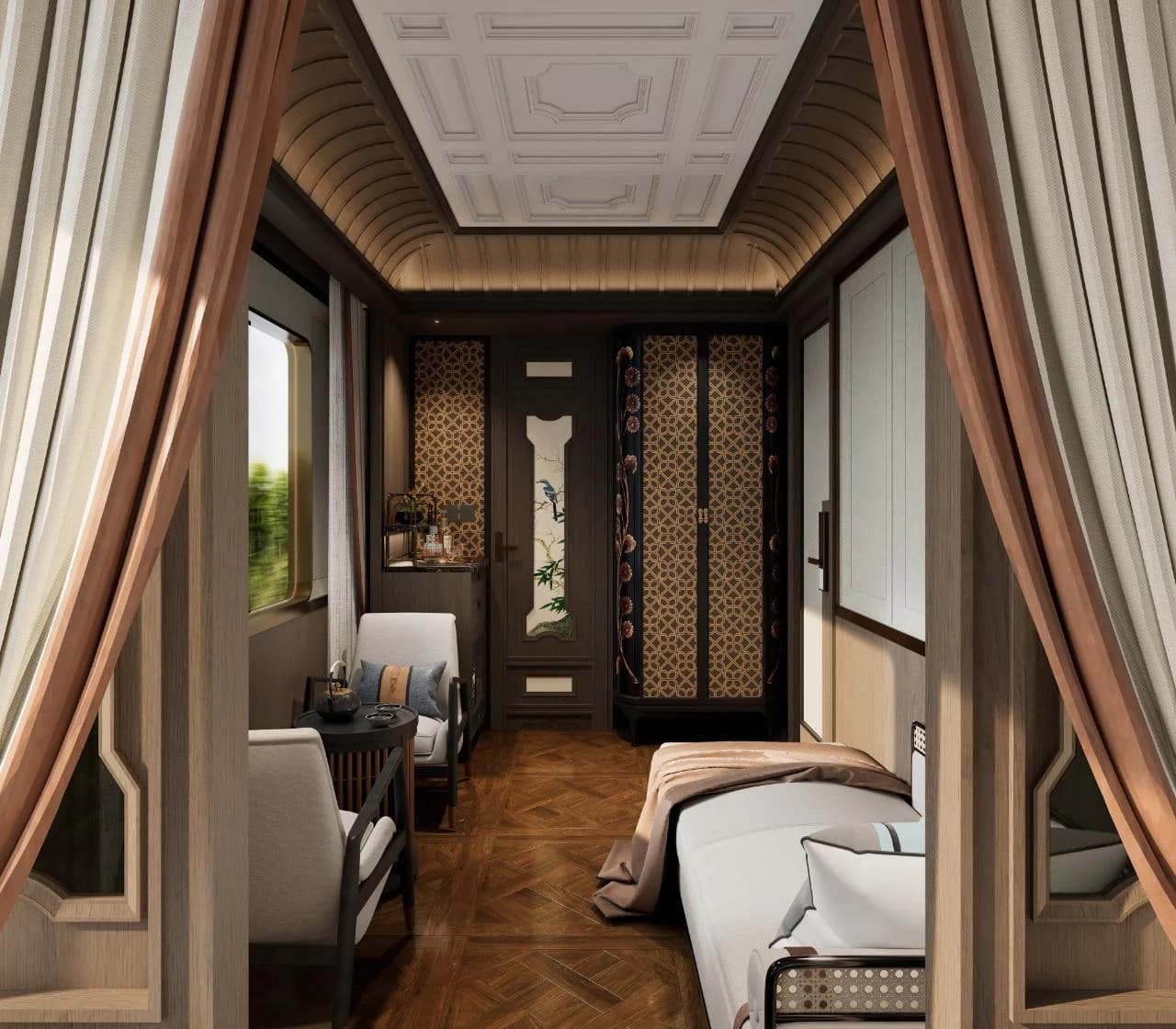
These specifications help you compare the two categories, but they do not answer every room question. A floor-area figure does not give door or bed measurements, a photograph does not confirm your assigned room, and a capacity count does not show live availability. Use the published pages to define what is known, then get the details that matter to you in writing.
Lanyue and Yayun at a Glance
The official room page describes two twin categories with different published areas and layouts. Lanyue is 14 m²; Yayun is 10.2 m². The product pages list a private bathroom in both categories. Their published configuration figures are category totals, not a current room allocation or availability report.
| Specification | Yunqi Lanyue | Yunqi Yayun |
|---|---|---|
| Published floor area | 14 m² | 10.2 m² |
| Carriages & room count | 2 carriages · 6 suites (12 guests) | 10 carriages · 40 rooms (80 guests) |
| Bathroom configuration | Private en-suite bathroom | Private en-suite bathroom |
| Published room features | Twin beds, two-seat sofa, minibar, private wardrobe | Combinable twin beds, folding sofa, storage |
| 2027 Xinjiang reference fare (May–Aug) | CNY 118,880 / guest | CNY 98,880 / guest |
| 2027 Xinjiang reference fare (Sep 14) | CNY 128,880 / guest | CNY 108,880 / guest |
- Yunqi Lanyue: 14 m²; two carriages; six suites; 12 guests; published features include a two-seat sofa, minibar, private wardrobe, and en-suite bathroom.
- Yunqi Yayun: 10.2 m²; ten carriages; 40 rooms; 80 guests; published features include twin beds that can combine, a folding sofa, storage, and an en-suite bathroom.
Both are described as two-person twin categories, but the published feature descriptions are not identical. Lanyue's listed features include a two-seat sofa, minibar, and private wardrobe. Yayun's list includes a folding sofa, storage, and twin beds that can be combined. Read these as published category details, not as a promise that a particular assigned room will have a specific arrangement for every departure.
The capacity figures also need a careful reading. The website lists six Lanyue suites for 12 guests and 40 Yayun rooms for 80 guests. Together, those category figures total 92 guests, which matches the train overview's stated guest capacity. This arithmetic describes the published configuration. It does not mean there are currently six Lanyue suites or 40 Yayun rooms available for sale on a date you select.
If you compare the categories by area, Lanyue has 3.8 m² more published floor area than Yayun. If you compare the listed bed arrangement, Yayun is the category whose published description says the twin beds can combine. If you compare the printed features, Lanyue lists a minibar and private wardrobe, while Yayun lists a folding sofa and storage. These are different ways to compare the public descriptions; none should be extended into an unverified conclusion about comfort, access, or room assignment.
The booking page also publishes reference fares for the 18-day 2027 Xinjiang program. For the six departures from May 18 through August 24, the published per-guest reference fare is CNY 118,880 for Lanyue and CNY 98,880 for Yayun. For September 14, the respective published figures are CNY 128,880 and CNY 108,880 per guest. These are dated reference amounts, not a guarantee of availability or the final price for a booking.
A room comparison is most useful when it keeps four kinds of information separate: the area figure, the listed room features, the capacity configuration, and the fare. The first three come from the room description; the fare depends on the departure date shown on the booking page. None of these fields confirms the exact terms or room number assigned to your party.
Use the room page to decide which questions to ask next. If the larger published area matters, ask for the current plan or dimensions that would let you assess a specific circulation need. If the combinable beds matter, request confirmation for the assigned category and departure. If price matters, compare the date and per-guest basis on the booking page with the written quote. Do not fill an unanswered field with an assumption drawn from another category.
A side-by-side note can keep the comparison focused: record the category name, published area, listed furniture, published bathroom statement, capacity figure, fare source, and one unanswered question for each room. Keep the information source beside each entry. This makes it easier to see whether a difference is a published fact, a personal preference, or a detail you still need the booking contact to confirm.
How Much Difference Does 3.8 m² Make?
The difference between the published areas is 3.8 m²: Lanyue is 14 m² and Yayun is 10.2 m². That is a measurable category difference, but it is not a floor plan. It does not tell you the shape of either room, the clear width of a walkway, the location of furniture, or how much usable space remains around a bed.
Area is a single total. Two rooms with different layouts can use the same floor area in different ways, and a larger total does not establish the dimensions of a doorway, bathroom, bed, storage compartment, or turning space. The public room pages do not provide all of those measurements. Avoid converting the 3.8 m² difference into a claim that one room is accessible, easier to move through, or suitable for a specific mobility aid.
Think about your own use of the room rather than treating square metres as a comfort score. You may care about where two people can place personal items, whether a sofa is useful, how the bed arrangement works, or whether you can move a device to the place where you need it. The published features can help you form questions, but they do not show every measurement or movement path.
If a specific dimension will affect your decision, ask the booking contact for that measurement in writing. Be precise about what you need to assess: a doorway, the gap beside a bed, the bathroom entrance, the position of a fixture, or space for an item you plan to bring. Do not request a generic “room size” if the issue is actually a particular clearance or equipment fit.
A room-area figure is also not luggage capacity. The project materials do not establish how many bags fit in either room, their maximum dimensions, or how they would be stored during a departure. If you need to bring a large case, mobility aid, medical device, or specialist equipment, give the item's dimensions and ask how it can be accommodated. A photograph cannot verify that it fits.
The comparison can still be useful without overreading it. Lanyue's published area is larger by 3.8 m²; that is a factual distinction. Whether the difference matters to you depends on your priorities and on details that may not be published. Instead of asking whether 14 m² is “comfortable enough,” define the practical condition you need to evaluate and request the evidence that answers it.
Room images can help you understand design intent, but they should not be used to estimate precise measurements. Perspective, camera position, furniture placement, and image editing can affect how spacious a room appears. The official English rooms page marks its Lanyue and Yayun interior images as renderings. A rendering can illustrate a planned appearance; it is not a measurement document or proof of the exact assigned room.
The Chinese-language official gallery offers another kind of reference: archived photographs of rooms from the brand's launch collection. Its image labels identify the spaces shown, and the page states that the archive does not document the 2027 first operating departure. A photograph can show the photographed launch space, but it cannot guarantee that a room in a future departure will have the same condition or assignment.
The total area figure does not allocate space among sleeping, living, storage, and bathing zones. Even when a page describes those zones, it does not give their individual dimensions. If you need a particular surface or clearance, request that exact measurement instead of treating the overall room area as a substitute. That is especially important when you need to fit a device or move through a specific part of the room.
Use a simple comparison note with four fields: published area, published features, the measurement you still need, and the answer received for your departure. That keeps the 3.8 m² difference from taking on more meaning than it can support. It also helps two travelers compare the same factual question rather than reacting differently to a rendering.
Beds, Bathroom and Privacy
The current room descriptions present both categories as twin accommodation with an en-suite bathroom. Lanyue's page lists a two-seat sofa, minibar, and private wardrobe. Yayun's page lists twin beds that can be combined, a folding sofa, and storage. These are published category descriptions; exact measurements and the final operating setup still require confirmation for your booking.
The word “twin” tells you the category is designed around two sleeping places, but it does not supply mattress width, length, height, bedding type, or space between the beds. If any of those details matters to you, ask for the measurement and arrangement rather than estimating it from a photograph. A room image may show one configuration but cannot establish that it will be repeated in your assigned space.
For Yayun, the published description says its twin beds can be combined. That is more specific than a generic statement that the room has twin beds, but it still leaves booking questions. Ask whether the combined arrangement is available for the date and assigned room, whether it must be requested before confirmation, and whether the final itinerary or quote records the request. Do not assume that a published feature guarantees a particular room setup.
For Lanyue, the published description names a two-seat sofa, minibar, and private wardrobe. It does not supply dimensions, capacity for personal luggage, electrical details, or an equipment placement plan. If one of these features affects your decision, ask the operator to clarify the exact current configuration. Do not infer storage volume, appliance operation, or the position of furniture from an image alone.
Both published room descriptions state that the categories have an en-suite bathroom. That confirms a stated room feature, not the shape of the bathroom or the measurements of its door, shower, basin, or turning area. Ask for a current bathroom plan or precise description if you need to assess a specific requirement. Do not assume that a private bathroom implies step-free access or that it meets any individual's accessibility needs.
The official English rooms page labels its illustrated Lanyue and Yayun interiors as renderings. The official gallery separately presents selected archived launch photographs. Those two image types answer different questions. A rendering communicates an intended design; a photograph records a real space at a particular time. Neither image type confirms the room number or condition that will apply to a future departure.
The gallery's room archive identifies photographs from both categories. It includes Lanyue bedroom and bathroom views and Yayun room views, but the page states that it does not have a confirmed real photograph of Yayun's en-suite bathroom. Do not use a Lanyue bathroom photograph as evidence for the layout or condition of a Yayun bathroom. The written room description says both categories have an en-suite bathroom; the image archive has a narrower scope.
Before choosing, distinguish these questions:
- What does the current published room description say?
- Which detail is only visible in a rendering?
- Which image is an archived photograph, and what space does its caption identify?
- Which measurement or arrangement do I need confirmed for my own use?
- Has that detail been written into the quote or room confirmation for my departure?
Privacy is also more specific than a room category name. The pages describe private room categories, but they do not establish every detail of sound insulation, door locking, curtain coverage, or privacy between sleeping and living zones for a particular operating room. If one of those details is important, ask the provider directly and request a clear answer. Do not infer it from decorative screens or a rendering.
Do not use bedding descriptions to make a medical or ergonomic judgment. A photo cannot show mattress firmness, bedding composition, or whether a bed supports a particular condition. If you need a specific sleep arrangement for health or mobility reasons, consult the appropriate professional for personal advice and ask the seller for the exact room information that professional needs to assess.
The comparison should end with a short record of what is stated and what is not. You might record that the published page lists an en-suite bathroom, while its dimensions remain unprovided. You might note that Yayun beds are described as combinable, while the final room setup remains to be confirmed. This avoids letting a broadly worded feature turn into a detailed promise.
Who Should Choose Each Room?
The published specifications can help you decide which room category to investigate first, but they cannot select a room for you. Lanyue offers the larger listed area and a two-seat sofa, minibar, and private wardrobe. Yayun has the lower published reference fare on the listed dates and a description that says its twin beds can combine. Your priorities determine which facts deserve follow-up.
Lanyue may be the first category to examine if the larger 14 m² published area or the listed sofa and wardrobe matter to your preferences. That does not mean it will be more comfortable for every traveler, or that it meets a mobility requirement. Ask for the exact dimensions, layout, and arrangement needed to evaluate your specific use.
Yayun may be the first category to examine if its lower listed reference fare or the published combinable twin-bed feature matters to you. Its larger published room count is a configuration detail, not proof that more rooms are currently available for your date. Check the quoted fare and request confirmation of the bed arrangement for the room assigned to your booking.
For two people traveling together, compare how each person will use the room rather than assuming they share the same priorities. One person may value a particular bed arrangement; the other may care about storage or a bathroom detail. Make a list of the facts each person needs and compare those with the published descriptions. If a preference is essential, say so before booking and request written confirmation.
For a family, caregiver, or group, avoid extrapolating from the room name or total guest capacity. The public pages list categories and configuration totals, but they do not state how related travelers will be assigned, whether adjacent rooms are possible, or whether an individual request can be met. Ask about the exact party arrangement. Treat proximity and room number as unknown until they are included in the written confirmation.
For a traveler with accessibility, mobility, medical-device, or space needs, neither area figure is enough to establish suitability. Give the operator the specific task or device you need to accommodate and request measurements of the relevant doorway, route, bathroom feature, and furniture clearance. Do not rely on a broad “accessible” or “spacious” description if it does not answer the practical question you need resolved.
Budget can be one part of your choice. The booking page lists separate per-guest reference fares for the 2027 Xinjiang program by room category and date. Compare the exact departure and category, then ask for the current written quote. The public fare is not a promise of inventory, a room assignment, or a final amount for your party. The fare guide can help you compare the published numbers without blending them with the room descriptions.
A useful preference exercise is to sort each factor as essential, preferred, or flexible. Essential means you should not book unless the specific requirement is confirmed. Preferred means it may influence your choice but could be traded for another feature. Flexible means the published descriptions are sufficient for now. This is a personal decision tool, not a product rating or an accessibility assessment.
Once you have made that list, compare it against evidence rather than labels. A room's larger area may be relevant, but it is not proof of adequate clearance. A combined-bed description may be useful, but it is not a booking assignment. A lower listed fare may matter, but it does not tell you the full service scope. Make the decision only after the written answer covers the details you have marked essential.
For two travelers with different priorities, write down what each person considers essential before comparing the categories. One person may be comfortable with either published area but need a specific bed setup; another may value a larger listed floor area but be flexible about the bed arrangement. Treat these as examples of preferences to discuss, not proof that one room will meet a particular need. If the preference is essential, ask for confirmation tied to the booking.
Why Room Inventory Matters
The rooms page lists six Lanyue suites across two carriages and 40 Yayun rooms across ten carriages. Those are published configuration figures. They are not a live inventory count for any departure, and they do not show whether a room is currently available, held, assigned, or sold.
A larger published count does not prove that one category will be available longer than the other. Current availability can change as bookings and operating arrangements change, and the public page does not expose an inventory feed. Do not infer scarcity, sell-out status, or a likely room assignment from the category totals. Ask for the current status of your chosen date and category.
A quote request should name the product, departure date, room category, number of travelers, and the occupancy you want. Ask the booking contact to state whether the category is available for that date and whether it is being held for you, if a hold is offered. Do not assume that a price quote reserves an inventory item or that a reply about availability applies to a different date.
If you receive an answer about a category but not an assignment, keep the two statements separate. “Yayun is available” and “room number X has been assigned” would answer different questions. Do not treat one as proof of the other. Ask which details can be confirmed now and which will appear in a later booking document.
If you need a specific arrangement, add it to the request before payment. Examples include the published combinable twin-bed setup, a particular room category, or a proximity request for several rooms. A request is not confirmation. Ask for the answer to appear in the written quote or booking confirmation, and check that the final document uses the same room and date you selected.
Do not assume that room assignment follows a first-come policy, that the larger inventory means a preferred location, or that two bookings will be placed together. Those rules are not established by the public room pages. Ask how requests are handled and which details can be confirmed. If a detail cannot be guaranteed, decide whether the remaining uncertainty is acceptable before you pay.
The published capacities can still help with general context. Six Lanyue suites for 12 guests and 40 Yayun rooms for 80 guests show the scale of each room category in the public configuration. They do not reveal how many guests have booked, how rooms are distributed by date, whether any rooms are held back, or how assignments are made. Avoid treating a capacity figure as a demand statistic.
Price and availability should be confirmed together. The booking page lists reference fares by category and date, but final prices and room details require written confirmation. Ask the quote to state the room category, departure date, fare basis, occupancy, and any route supplement separately. If the amount changes from the published figure, request an explanation tied to your exact selection.
Keep the source page and the response date with your notes. A screenshot of a room count is a record of what the site displayed at that moment, not proof of what can be booked later. Recheck the official page before you send an enquiry, then rely on a current written response for your actual departure.
Room Questions to Ask Before Booking
Before paying, turn the room descriptions into a short set of questions about the exact category and departure. The public page tells you the listed area, selected features, and category capacities. The written quote or confirmation should tell you which category is being offered to your party and what arrangements have actually been accepted.
Start with the identity of the offer. Confirm the 18-day Xinjiang product, date, edition if provided, room category, number of guests, and the price basis. If the room page and the quote use different names, ask whether they refer to the same category. Do not resolve a wording mismatch by relying on the color or furniture in a photograph.
Then ask about the details you personally need. The list below separates published facts from questions requiring a direct answer:
- Room category and occupancy shown in the written quotation.
- Whether the assigned category is Lanyue or Yayun.
- Whether a requested bed configuration is available for the assigned room.
- Any measurement you need for a bed, doorway, bathroom entrance, or furniture clearance.
- How an essential mobility aid or medical device can be accommodated.
- Whether a room-location or adjacent-room request can be confirmed.
- The current per-guest fare for your date and any separate route supplement.
- The published room feature you are relying on, stated in the booking documents if material.
- The current room availability and whether any hold is offered.
- What the booking documents say about changes to the assigned room or operating arrangement.
Be precise when you describe an accessibility or equipment request. Instead of writing only “I need an accessible room,” explain the action or dimension that matters to you, such as the width needed for a device or the bathroom feature you must use. Ask the provider for the corresponding measurement or plan. If the information is unavailable, consult the relevant professional and decide whether you can proceed without it.
For image-related questions, identify the exact page and caption you saw. Ask whether the image is a rendering or an archived photograph, which category it depicts, and whether the feature is part of the written room specification. The English rooms page labels certain interior images as renderings; the Chinese gallery labels its launch photographs as an archive and states that it is not a 2027 operating record.
The current booking page also matters for how you send the question. On November 15, 2026, it stated that online submission was unavailable and directed travelers to prepare an enquiry draft and send it through the WhatsApp or email contacts shown there. The page asked users to leave identity documents and payment information out of the initial enquiry. Check the live page before contacting Baiyun Express because the notice and channels can change.
A room enquiry can be concise while still being complete. State the product, preferred date, party size, preferred category, and any required bed or access detail. Ask for the current written quote, category availability, and the exact information you need to decide. Keep sensitive information out of an initial enquiry. If the answer is about a different date or category, ask for a response that names your requested selection.
After the reply, label each item as publicly listed, image-only, requested, confirmed for this booking, or still open. Keep the status beside its source and the date or category it applies to. This prevents a visual impression from turning into an assumed feature and makes a follow-up easier: send the provider only the open items that affect your decision, and ask for a written answer tied to the correct date and category.
Lanyue and Yayun Room FAQs
Which room category is larger?
Lanyue is listed at 14 m² and Yayun at 10.2 m², a published area difference of 3.8 m². The area figures do not describe doorway, bed, bathroom, storage, or movement clearances. If you need one of those measurements, request it for the room category and departure you are considering.
Do both Lanyue and Yayun have an en-suite bathroom?
Yes. The current published descriptions for both categories list an en-suite bathroom. That statement does not provide a bathroom plan or dimensions. The official launch gallery includes a Lanyue bathroom photograph but says it does not have a confirmed Yayun bathroom photograph. Use the written description for the published feature and request additional details if a specific bathroom arrangement matters.
Can the Yayun beds be combined?
The current Yayun description says the twin beds can be combined. Ask whether that arrangement is available for the room assigned to your departure and have the answer included in your written booking details. A category-level feature does not identify the exact room or confirm the requested setup for an individual booking.
Are the room pictures photographs of the 2027 train?
Not all of them. The English rooms page labels its Lanyue and Yayun interior images as renderings. The Chinese gallery labels selected real photographs as an archive of launch spaces and says the archive is not a 2027 first operating record. Read each page's label and caption; do not treat an image as proof of future room assignment or condition.
Does the 14 m² Lanyue room guarantee better comfort?
No. The published area is larger, but the pages do not establish a personal comfort result, room dimensions, noise level, or suitability for a particular traveler. Compare the listed features with your own needs and request any measurement or arrangement that matters. The room description cannot replace an individual assessment.
Does the listed room count mean the category is available?
No. The published figures describe category configuration: six Lanyue suites for 12 guests and 40 Yayun rooms for 80 guests. They do not show live inventory for a particular departure. Ask for current availability for your date and request written confirmation of the category offered to your party.
Can I request a particular room number or carriage?
The public room pages list category and carriage totals, but do not explain how individual rooms are assigned or promise a room number or carriage. If location matters, ask whether the request can be recorded and whether it can be confirmed in writing. Treat it as a preference until the booking documents identify the assignment.
Are the displayed fares final?
The booking page shows published per-guest reference fares for the 2027 Xinjiang dates. It also says final prices require written booking confirmation. Check the current amount, date, room category, occupancy, and any separate route supplement in your own written quote before paying.