
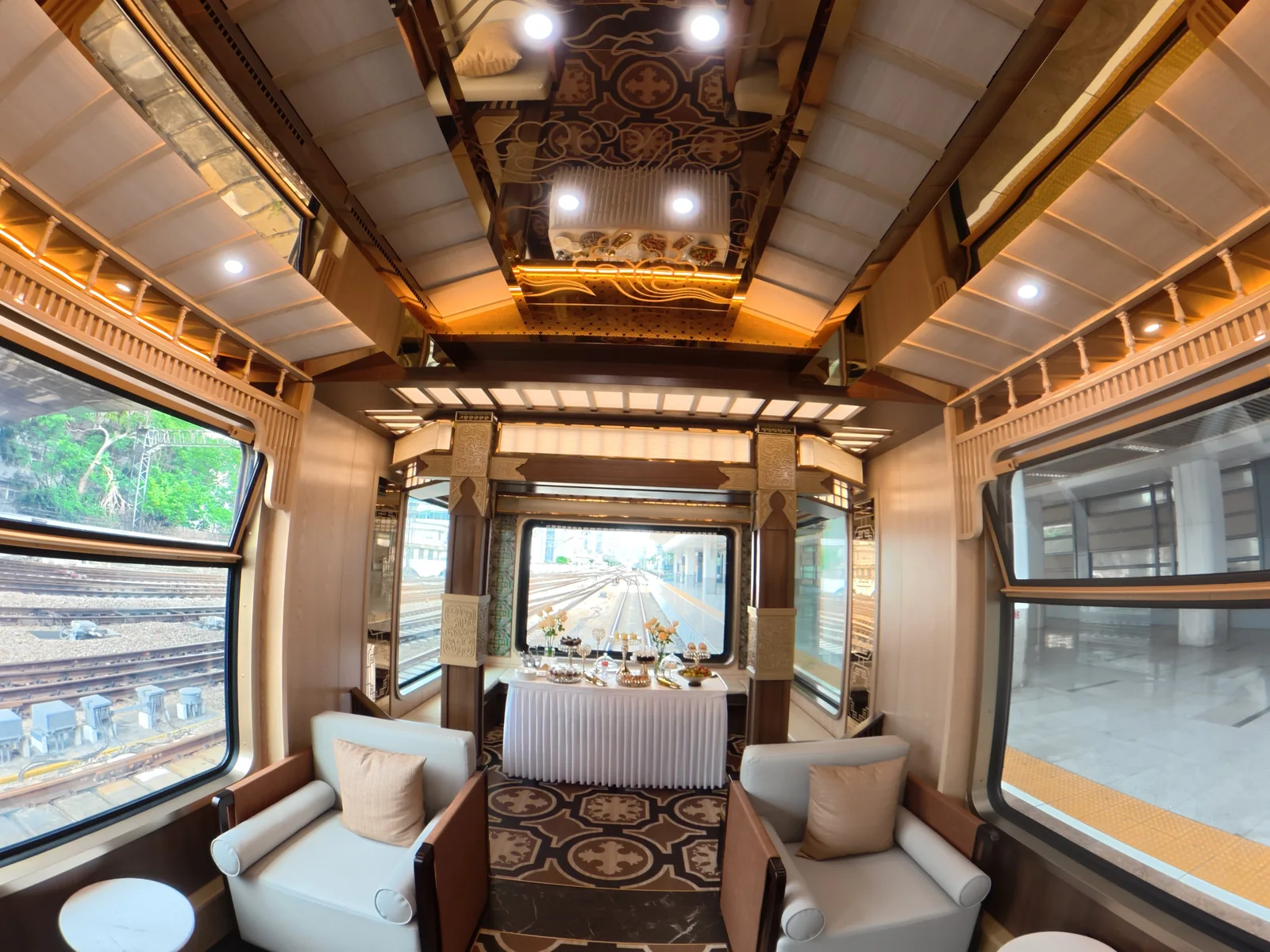
On multi-day rail journeys such as the 18-day Guangzhou–Xinjiang loop and the separate 11-day Cloud Sanctuary route through Guangxi and Yunnan, shared carriages shape how daytime transit hours actually feel—providing spaces to drink tea, watch desert or karst scenery, dine at window tables, play cards or consult the accompanying doctor without crowding narrow sleeping corridors.
Because Baiyun Express's public pages combine archived August 2026 brand-launch photographs with official interior renderings and axonometric cutaways, knowing what each carriage is built to provide—and which operating rules still require written confirmation for your chosen departure—lets you evaluate the train accurately before booking with Danny Dong Yi.
Baiyun Express Shared & Support Carriages at a Glance
Private cabins define overnight rest—six 14 m² Yunqi Lanyue suites across two carriages for 12 guests, plus forty 10.2 m² Yunqi Yayun twin rooms across ten carriages for 80 guests—while shared and support cars carry the social, culinary and health infrastructure of the 18-car formation. Limiting the entire train to 92 guests keeps passenger density far lower than conventional multi-berth tourist trains.
Use the summary table below to distinguish each space's published layout, available visual documentation, and departure-specific operational questions:
| Carriage / Space Name | Primary Role | Published Spatial & Design Features | Details to Confirm in Writing |
|---|---|---|---|
| Yunju · Xianting (云聚·闲庭) | Welcome & Tea Lounge Car | Four-door vestibule reception (Gate · Forecourt · Gallery), viewing lounge, tea bar, performance area, storage; Lingnan & Huxiang motifs | Boarding reception sequence, daily tea bar hours, included vs. paid teas, hand-luggage staging |
| Yunyan · Qinghuan (云宴·清欢) | Chinese Banquet Dining Car | Seats 48 guests at rosewood-and-brass window tables with Hunan-embroidered runners, dougong ceiling, buffet, walk-in wash area, AV & restrooms | Single vs. staggered dining shifts for your guest count, beverage inclusions, table assignment policy |
| Yunshang · Guanlan (云赏·观澜) | Tail Promenade & Observation Car | Rear Aiwan Pavilion with red maples, panoramic window lounge, service bar, two private game/mahjong rooms, warm amber night lighting | Private game-room booking rules or time limits, evening quiet hours, bar menu inclusions |
| Yunchu · Yushan (云厨·御膳) | Dedicated Kitchen Car | Professional galley with cooking equipment and ingredient storage supporting onboard meals across the route | Supplier-level halal verification, cross-contact controls, severe allergen handling and packed meals |
| Yunhu · Anyu (云护·安隅) | Onboard Medical Room | Dedicated medical duty station for the accompanying traveling doctor with storage for basic medical supplies | Scope of basic supplies, medication refrigeration, cabin power for medical devices & hospital transfer protocol |
Look at how the 18-carriage formation fits together as a whole. Published room floorplans reference Carriages 7 and 11 for the three-suite Yunqi Lanyue layout and Carriages 2, 3, 4, 5, 6, 12, 13, 14, 15 and 16 for the four-room Yunqi Yayun layouts, leaving dedicated positions in the consist for reception, dining, kitchen, observation, medical and crew/operational functions.
That ratio—five dedicated public and support spaces serving at most 92 guests—explains why life aboard Baiyun Express differs structurally from conventional 16-car sleeper trains carrying several hundred passengers. Even when all six Lanyue suites (12 guests) and forty Yayun rooms (80 guests) are occupied, daytime movement spreads naturally across private cabins, Xianting's tea booths, Qinghuan's 48 dining seats and Guanlan's rear lounge and two game rooms.
How heavily you use those shared carriages also depends on which Baiyun Express itinerary you book. On the 18-day Guangzhou–Xinjiang loop—which combines eight overnight rail legs with full-day scenic rail crossings through the Hexi Corridor on Day 3 and back from Golmud via Chongqing on Days 17 and 18—shared lounges become your daytime living room for days at a time. On the separate 11-day Cloud Sanctuary route through Guangxi and Yunnan, rail segments primarily link overnight transitions between daytime karst, border-waterfall and highland excursions, so shared spaces centre more on evening dining, morning breakfast and relaxed post-excursion tea.
Treat carriage numbers on website floorplans as representative configuration diagrams rather than a guaranteed coupling order for a future 2027 Xinjiang or 2026 Southwest China departure. Railway dispatch, maintenance rotations and charter configurations can alter exact car numbering or proximity between your sleeping cabin and the dining car. If minimising walking distance from your cabin to Yunyan · Qinghuan or Yunhu · Anyu is important for mobility reasons, state that requirement before paying a deposit and ask what placement can be confirmed in writing.
Yunju · Xianting: The Four-Door Welcome, Tea Bar & Lounge Car
Yunju · Xianting serves as the ceremonial threshold and daytime social heart of Baiyun Express. Rather than stepping from a station platform straight into a narrow sleeping-car corridor, boarding guests enter through an architectural sequence designed around Lingnan (Cantonese) and Huxiang (Hunanese) heritage.
Gate, Forecourt and Gallery: Spatial Layout Inside Xianting
Published carriage specifications describe how two adjoining vestibules combine to create a four-door reception zone arranged sequentially as Ceremonial Gate, Forecourt and Chinese Gallery. Latticework partitions, traditional floral and landscape cabinetry, moon-gate framing and palace lanterns establish visual separation between active boarding doors and calm interior lounge seating.
Beyond the gallery threshold, the carriage opens into three practical daytime zones showcased on both the carriages page and the interactive cutaway explorer: a central tea bar and reception counter backed by integrated service and storage cabinets; symmetrical window-facing booths along the central aisle for viewing, reading and conversation; and an open performance and salon area used for welcome ceremonies, small musical sets and route briefings—such as the Silk Road cultural salon scheduled during Day 3's Hexi Corridor transit on the 18-day Xinjiang itinerary.
View Yunju · Xianting specs and gallery on the carriages pageHow Guests Use Xianting—and What to Clarify Before Boarding
In daily operation across multi-hour daytime rail legs, Yunju · Xianting acts as a decompression lounge for travellers sharing 10.2 m² or 14 m² twin cabins. When one cabin companion wants an afternoon rest in private, the other can walk to Xianting's window booths for tea and scenery without needing to wait for dinner service.
Comparing the archived August 2026 launch photographs against the four official renderings on the carriages page shows how Lingnan and Huxiang design motifs translate into physical joinery: circular moon-gate framing behind the tea counter, carved timber lattice screens along the ceremonial corridor, warm lantern sconces and cushioned face-to-face window banquettes along the central aisle. On the published 2027 Xinjiang schedule, Day 1 begins with a welcome ceremony, live band performance and song-and-dance showcase upon boarding in Guangzhou, while Day 3 schedules Silk Road cultural salons during the Hexi Corridor crossing—events that rely on Xianting and Guanlan rather than cramped sleeping aisles.
Because public descriptions focus on spatial architecture rather than departure-by-departure service tariffs, ask Danny Dong Yi to clarify four operational points if they matter to your party:
- Embarkation flow and hand-luggage staging: whether Day 1 document verification or welcome tea takes place in Yunju · Xianting while main suitcases are placed in cabins, and what Xianting's integrated storage zone holds during excursions.
- Daily tea bar staffing and beverage scope: which Chinese teas, infusions or coffees at the Xianting counter are complimentary throughout transit days versus offered as paid specialty selections.
- Scheduled salon and performance hours: when live music, route briefings or cultural talks are hosted in Xianting so guests seeking quiet reading can choose between Xianting and Guanlan.
- Open-seating etiquette on scenic corridors: whether window booths in Xianting remain unreserved open seating for all 92 guests throughout the journey.
Keep charter versus individual-departure operations separate when reading past passenger accounts online. On the 2027 Xinjiang calendar, four dates (May 18, July 16, August 5 and August 24) are sold out as full-train government or private charters where the chartering organisation may customise welcome receptions or salon schedules inside Yunju · Xianting. Individual travellers booking June 6, June 26 or September 14 should always rely on the standard departure notice issued for their own date.
Yunyan · Qinghuan & Yunchu · Yushan: Dining Hall and Galley Operations
Onboard dining on Baiyun Express relies on two paired carriages working in tandem: Yunyan · Qinghuan as the front-of-house Chinese banquet hall and Yunchu · Yushan as the dedicated back-of-house kitchen car. Separating heavy cooking equipment and ingredient storage into Yunchu · Yushan keeps kitchen heat, prep clatter and heavy provisions out of the passenger dining room.
Inside the 48-Seat Yunyan · Qinghuan Dining Car
Published specifications state that Yunyan · Qinghuan seats 48 guests at tables arranged along both window walls of the carriage. The interior pairs a traditional dougong bracket-inspired ceiling with rosewood-and-brass dining tables dressed in Hunan-embroidered (Xiang embroidery) runners, keeping sightlines open to passing landscapes during breakfast, lunch and dinner.
At the service end of the carriage, published floorplans and interactive hotspots identify a buffet counter, tableware and linen storage, audiovisual equipment for group announcements or cultural presentations, onboard restrooms, and a dedicated walk-in wash area separated from the dining tables so passengers can wash up comfortably before and after meals without walking back through several carriages to their sleeping cabins. Travellers who carry insulated flasks for mountain excursions in Xinjiang or Yunnan can also ask onboard staff where hot drinking water refills are stationed across Qinghuan, Xianting and private rooms.
Pay close attention to two practical details visible in the published specifications and launch photographs. First, seating capacity is 48 guests against a full-train manifest of 92 guests, meaning near-capacity departures cannot seat every passenger simultaneously in a single sitting; staggered meal windows or two structured shifts depend on your departure's headcount and operating plan. Second, archived photographs of Yunyan · Qinghuan show four-person face-to-face booths lining the panoramic windows. Couples travelling in two-person Yunqi Lanyue or Yunqi Yayun cabins should expect convivial shared four-tops during busy sittings unless specific seating arrangements are confirmed onboard.
Tracing the published 2027 18-day Xinjiang day-by-day meal schedule also clarifies how often you actually dine in Yunyan · Qinghuan versus off-train venues. Onboard 'Cantonese & Hunanese Signatures' meals prepared in Yunchu · Yushan anchor rail transit windows: Day 1 dinner leaving Guangzhou; Day 2 breakfast and lunch into Chongqing; all three meals on Day 3 across the Hexi Corridor; transit breakfasts arriving into Urumqi (Day 4), Yining (Day 8), Kuqa (Day 11 on Tianshan Route B and Route C), Kashgar (Day 12) and Korla (Day 15); Day 16 breakfast and lunch at Golmud; all three meals on Day 17 returning toward Chongqing; and Day 18 breakfast and lunch into Guangzhou (with Day 18 dinner governed by actual train arrival timing). Off-train lunches and dinners shift to regional specialties—from Chongqing hotpot and Burqin cold-water fish to Sayram whitefish, Taxkorgan yak hotpot and Kashgar roast whole lamb—while beverage inclusions aboard Qinghuan must be verified in your written quote.
Check onboard vs. off-train meals across the 18-day Xinjiang itineraryYunchu · Yushan Kitchen Car & Dietary Verification Boundaries
Yunchu · Yushan is equipped with professional cooking appliances and cold/dry storage to prepare hot meals across multi-day rail transits—such as the outbound Chongqing-to-Urumqi Hexi Corridor crossing and the return Golmud-to-Guangzhou legs. Having a full kitchen car rather than reheated airline-style trays allows fresh regional dishes on transit days.
However, travellers with strict religious dietary laws, celiac disease or life-threatening food allergies must observe a firm evidence boundary. Baiyun Express's public website does not verify supplier-by-supplier halal certification, dedicated halal-only kitchenware separation inside Yunchu · Yushan, cross-contact controls, or ingredient-level allergen tracing across every onboard meal, hotel breakfast, off-train banquet and excursion box lunch.
When checking the live booking page, remember that typing a halal, kosher, vegetarian or allergy requirement into the enquiry draft—and sending it via official WhatsApp or email while online form submission is unavailable—submits a pre-sales request, not proof that every kitchen can meet your standard. Spell out the exact level of compliance you need rather than using a single broad label: state whether 'no pork and no cooking wine' suffices, or whether you require halal-certified meat suppliers, dedicated utensils and strict cross-contact separation inside Yunchu · Yushan as well as across off-train hotels, grassland camps and highway restaurants where the train's kitchen car is not present. Before paying a deposit, obtain itemised written confirmation covering every meal setting on your itinerary.
Prepare a dietary or booking enquiry for written confirmationYunshang · Guanlan: Panoramic Tail Lounge, Game Rooms & Aiwan Pavilion
Coupled as the tail carriage of the formation, Yunshang · Guanlan is designed as a promenade salon combining panoramic landscape viewing, afternoon recreation and relaxed evening conversation. Whereas Yunju · Xianting anchors welcome ceremonies and tea reception near the boarding sequence, Guanlan draws passengers rearward toward open multi-aspect views.
Four Distinct Zones Inside the Tail Observation Car
Reviewing the interactive cutaway hotspots alongside archived brand-launch photographs shows four distinct functional zones arranged along Yunshang · Guanlan. First, the symmetrical panoramic lounge lines both sides of the carriage with upholstered armchairs and small side tables framed by decorative Chinese flower windows.
Second, the panoramic service bar sits between the open lounge and the enclosed compartments, serving tea and light refreshments while acting as an acoustic buffer. Third, two enclosed private game rooms offer dedicated tables for mahjong, chess, cards or quiet small-group conversation without disturbing readers in the main salon—and without crowding private sleeping cabins. Fourth, the rear end of the carriage culminates in the signature Aiwan Pavilion vista: a three-window tail alcove inspired by Changsha's historic Aiwan Pavilion, detailed with red maple foliage, bronze-patterned columns, dougong bracket woodwork and warm amber ceiling illumination after dark.
Inspect Yunshang · Guanlan hotspots in the 5-carriage explorerPractical Etiquette and Reservation Questions for Guanlan
Yunshang · Guanlan's design reflects Baiyun Express's southern cultural roots: naming the tail vista after Changsha's Aiwan Pavilion and pairing crimson maple branches with traditional dougong brackets and Hunan embroidery accents links the train's Huxiang craftsmanship with the western landscapes unfolding outside the three rear-end windows. Archived launch-ceremony photographs also show solo and duet dance performances staged inside the observation lounge during the August 2026 showcase—illustrating the car's open floor versatility, though showcase performances do not guarantee identical nightly choreography on every commercial departure.
Because there are two private game rooms and one rear pavilion alcove shared among up to 92 passengers, demand on full daytime transits (such as Day 3 across the Hexi Corridor or Day 17 returning from Golmud to Chongqing) can naturally exceed two enclosed tables at peak afternoon hours. Public carriage pages describe the rooms' existence but do not publish a fixed reservation timetable, session length cap or fee schedule.
To help everyone enjoy the tail car smoothly, consider four practical points and confirm any essential rules before departure:
- Private game-room scheduling: ask whether the two mahjong and card rooms are booked through the train butler in timed blocks on transit days, and whether any usage fee or minimum bar order applies.
- Evening quiet hours and amber lighting: confirm when evening bar service winds down in Yunshang · Guanlan and whether late-night mahjong sessions are restricted to protect adjacent carriages.
- Photography etiquette at Aiwan Pavilion: the three-window tail alcove is a shared scenic viewpoint; handheld cameras work best in moving carriages so tripods never block aisles or emergency exits.
- Panoramic bar refreshments: check your written itinerary to distinguish complimentary daytime teas or snacks at Guanlan's service counter from chargeable evening drinks.
Yunhu · Anyu Medical Room, Accessibility & Onboard Service Team
Long-distance overland rail journeys across western China appeal strongly to retired travellers and multi-generational families, making onboard health support and physical circulation across carriages practical booking considerations rather than minor footnotes. Baiyun Express addresses onboard support through dedicated space and staffing—both of which should be understood clearly within their real operational limits.
Published train overview materials identify four core onboard service roles accompanying departures—train butler, traveling photographer, traveling doctor and tour leader—alongside smart cabin butler controls and elder-friendly interior design touches. Dedicated to the traveling doctor is Yunhu · Anyu, an onboard medical room configured as a consultation duty station with storage for basic medical supplies.
Pairing Private Room Choice with Shared-Carriage Access
How often you use Xianting and Guanlan also interacts with your sleeping-car choice. Travellers booking the 14 m² Yunqi Lanyue suite gain a dedicated two-seat living sofa, minibar and wardrobe inside their own cabin (six suites across two carriages), making in-room daytime lounging spacious. Travellers choosing the 10.2 m² Yunqi Yayun twin room (forty rooms across ten carriages, featuring combinable twin beds and a folding sofa) often treat Xianting and Guanlan as their primary daytime living rooms—making shared-lounge hours and proximity to your assigned sleeping carriage worth asking about during booking.
Compare Yunqi Lanyue and Yunqi Yayun private room layouts- What Yunhu · Anyu provides aboard the train: a dedicated room where the accompanying traveling doctor can conduct basic health checks, routine consultations and first-line emergency response while passengers are onboard.
- What Yunhu · Anyu does not replace: it is not an onboard hospital, surgical clinic, pharmacy stocked with personal specialist prescriptions, or guarantee against altitude sickness on the Pamir Plateau and Qinghai segments.
- Off-train excursion boundary: when guests leave the train for multi-day road loops in Hemu, Kanas, the Ili river valley (in 7-seat business vans) or Taxkorgan and Karakul Lake (in 2+1 coaches), emergency medical care relies on local county clinics, regional hospitals and road transfer protocols rather than the train carriage sitting at a railway station.
- Physical movement between carriages: walking from a Yunqi Yayun or Yunqi Lanyue cabin to Yunyan · Qinghuan for meals or Yunshang · Guanlan for views involves passing through moving rail corridors and inter-carriage vestibule connections.
Understanding how the four published onboard staff roles divide responsibilities across these shared spaces also helps you direct questions to the right person once onboard. The train butler handles day-to-day cabin comfort and shared-lounge service requests; the tour leader coordinates daily excursion schedules, group briefings (supported by audiovisual equipment in Yunyan · Qinghuan and salon space in Yunju · Xianting) and off-train hotel/vehicle handoffs; the traveling photographer documents route highlights and cultural moments (ask in advance how guest photographs are shared and state any personal privacy preferences); and the traveling doctor staffs Yunhu · Anyu.
Do not infer step-free wheelchair accessibility, vestibule doorway widths, grab-bar positions or shower transfer clearances from general references to elder-friendly details or from wide-angle renderings. Likewise, if you rely on a CPAP machine overnight, require refrigerated storage for insulin or biologics, or walk with a cane or rollator along moving train aisles, state the exact device dimensions, voltage/wattage requirements and physical clearances you need when enquiring about Yunqi Lanyue or Yunqi Yayun rooms, and consult your personal physician before committing to high-elevation itinerary segments.
Visual Evidence Audit: Launch Photographs vs. Design Renderings
When evaluating a luxury train priced around CNY 98,880 to CNY 128,880 per guest on its 2027 Xinjiang route, knowing whether you are looking at a camera photograph of built hardware or a computer rendering of design intent is vital. Baiyun Express's website maintains an explicit distinction across its visual library so prospective passengers can inspect both without confusion:
How to Cross-Check Three Official Pages Without Overreading Any Single Image
International travellers get the clearest picture of Baiyun Express's shared interiors by reading three official pages side by side. Start on the English carriages overview (/en/carriages) to read verified specifications, capacity figures and design renderings across all five passenger spaces plus the two support spaces (Yunchu · Yushan and Yunhu · Anyu). Next, open the interactive train experience (/en/train-experience) to see how all sixteen clickable hotspots—three in Xianting, three in Lanyue, three in Yayun, three in Qinghuan and four in Guanlan—fit together inside each carriage shell.
Finally, cross-check those layouts against the 20 archived brand-launch photographs on the official gallery page (/gallery). Note that the full 20-image archive is intentionally published only in Simplified Chinese rather than duplicated across foreign-language URLs, because its captions preserve original Chinese launch-showcase provenance records; English readers can view the exact same high-resolution WebP photographs directly at /gallery alongside the translated spatial explanations in this guide.
- Archived August 2026 brand-launch photographs (20 curated gallery assets plus English guide hero photos): Document real physical interiors and exterior livery photographed at the train's launch showcase. Within shared spaces, the archive includes three real photographs of Yunju · Xianting (central booth aisle, moon-gate tea bar, and ceremonial gallery cabinetry), two real photographs of Yunyan · Qinghuan (full-length window dining hall and four-seat table setting), three real photographs of Yunshang · Guanlan (symmetrical lounge, mahjong room, and three-window pavilion alcove), plus dance performances inside the observation car, interior lamp/column craft details and platform exterior views.
- Official interior renderings and floorplan diagrams (/en/carriages and /en/rooms): Computer-generated perspectives and schematic plans labelled as renderings or layout diagrams. Importantly, both published visuals for the support spaces—Yunchu · Yushan kitchen car and Yunhu · Anyu medical room—are official design renderings illustrating functional intent, not photographs of stocked operating rooms.
- Interactive 5-carriage axonometric cutaways (/en/train-experience): Angled 3D cutaway illustrations of Xianting, Lanyue, Yayun, Qinghuan and Guanlan designed to show how zones relate end-to-end inside each carriage shell rather than to provide millimetre engineering dimensions.
Even where archived August 2026 launch photographs confirm that the physical woodwork, embroidered table runners, mahjong tables, tea bar and pavilion columns were built and photographed aboard the train, keep the archive's explicit boundary in mind: a brand-launch showcase photograph is not a binding record of soft furnishings, floral arrangements, tableware or exact carriage condition on a 2027 commercial departure. Always rely on written contract specifications rather than background props in a photo when a specific amenity is essential to your trip.
Notice also what the 20-image launch archive omits so you do not misread room or support-car photos. While the gallery documents Yunqi Lanyue's bedroom and en-suite bathroom alongside Yunqi Yayun's jade-green and warm-walnut twin bedrooms, it does not include a confirmed photograph of Yayun's bathroom or interior photographs of Yunchu · Yushan and Yunhu · Anyu. Whenever an image is marked as a rendering or cutaway, treat it as an illustration of spatial layout and confirm critical physical details in writing.