
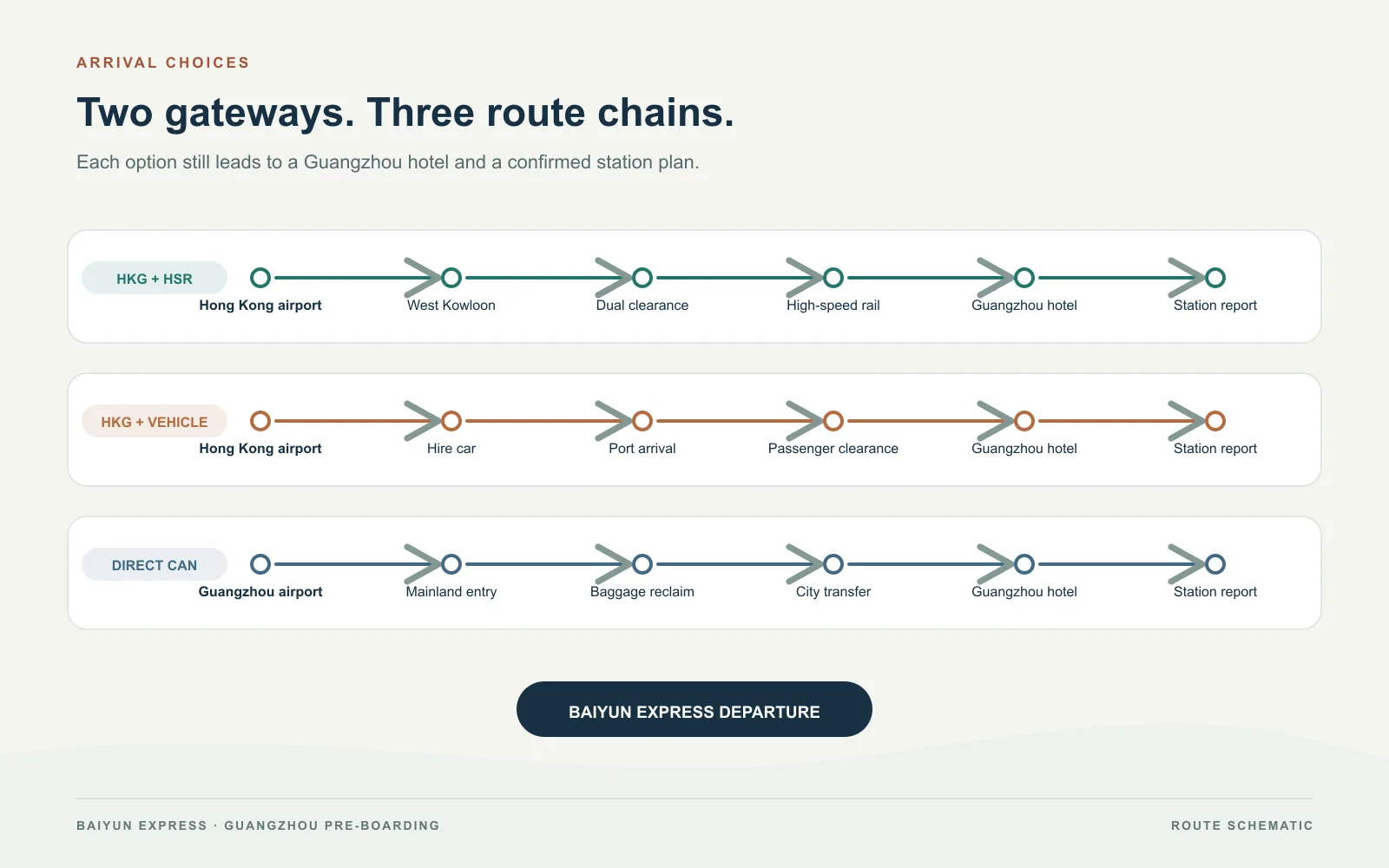
The workable route depends on your flight, passport, baggage, group size and tolerance for another transfer. HKG can add a useful Hong Kong stay, but it does not remove Mainland entry formalities. CAN is usually the simpler arrival chain when a suitable flight is available.
This guide compares the handoffs, timing risks and hotel staging for each option. It uses the published three-day pre-boarding extension as a planning reference. A dated written quotation and departure notice control the final hotel, transport, station and reporting arrangements.
Choose the Arrival Route Before You Choose the Flight
If you are planning a Hong Kong to Guangzhou transfer before a luxury train, first decide whether Hong Kong is part of the holiday or only an arrival airport. For most guests whose priority is a calm Guangzhou boarding, direct CAN arrival creates the shortest chain: international flight, Mainland arrival procedures, baggage collection, a pre-arranged city transfer and hotel check-in. It removes the Hong Kong to Mainland leg. It is not automatically the best flight for every origin or fare, but it is the easiest route to coordinate when a suitable connection exists.
HKG offers a different trade-off. You can add Hong Kong to the trip and continue to Guangzhou by high-speed rail from West Kowloon or by a permitted cross-boundary hire-car service. Both choices add another handoff. Rail adds a journey from the airport to West Kowloon and a booked train departure. A vehicle adds road traffic, a land port and a service that must be authorised to carry paying passengers across the boundary.
The HKG rail option is often easier to plan around a specific departure because the station and train time are visible before you travel. It still requires the party to reach the station, complete real-name checks, security and immigration, board on time, and arrange a last-mile ride in Guangzhou. The ticket protects only the rail segment. A delayed inbound flight can put the entire onward plan at risk if the transfer and train were booked separately.
A cross-boundary vehicle can suit a family or small party with bulky luggage, mobility needs or a hotel outside the rail corridor, provided the operator confirms a lawful service and the exact handoff. It is less useful to think of it as a guaranteed door-to-door shortcut. Passengers may need to leave the vehicle for clearance, traffic varies, and the vehicle or driver may not continue after the port.
Use this comparison as a routing decision, not as a promise of elapsed time. Pick the arrival airport first, then map the transfer to the hotel, the hotel to the reporting station and the recovery time between them. For an international arrival, plan to reach Guangzhou at least one day before boarding. A hotel night separates flight disruption from the train's written reporting window.
Before buying the international ticket, put the whole chain on one page: scheduled landing, airport exit, onward departure, border or station, Guangzhou arrival, hotel check-in and train reporting. Mark which bookings are linked and which are separate. An airline generally cannot protect a separately purchased train connection, and a hotel car cannot recover time lost to an earlier flight delay. If one late segment would make the next non-refundable booking unusable, move that segment to another day or buy a more flexible fare. The best route is the one with the clearest recovery option for your party, not the one with the most impressive map distance.
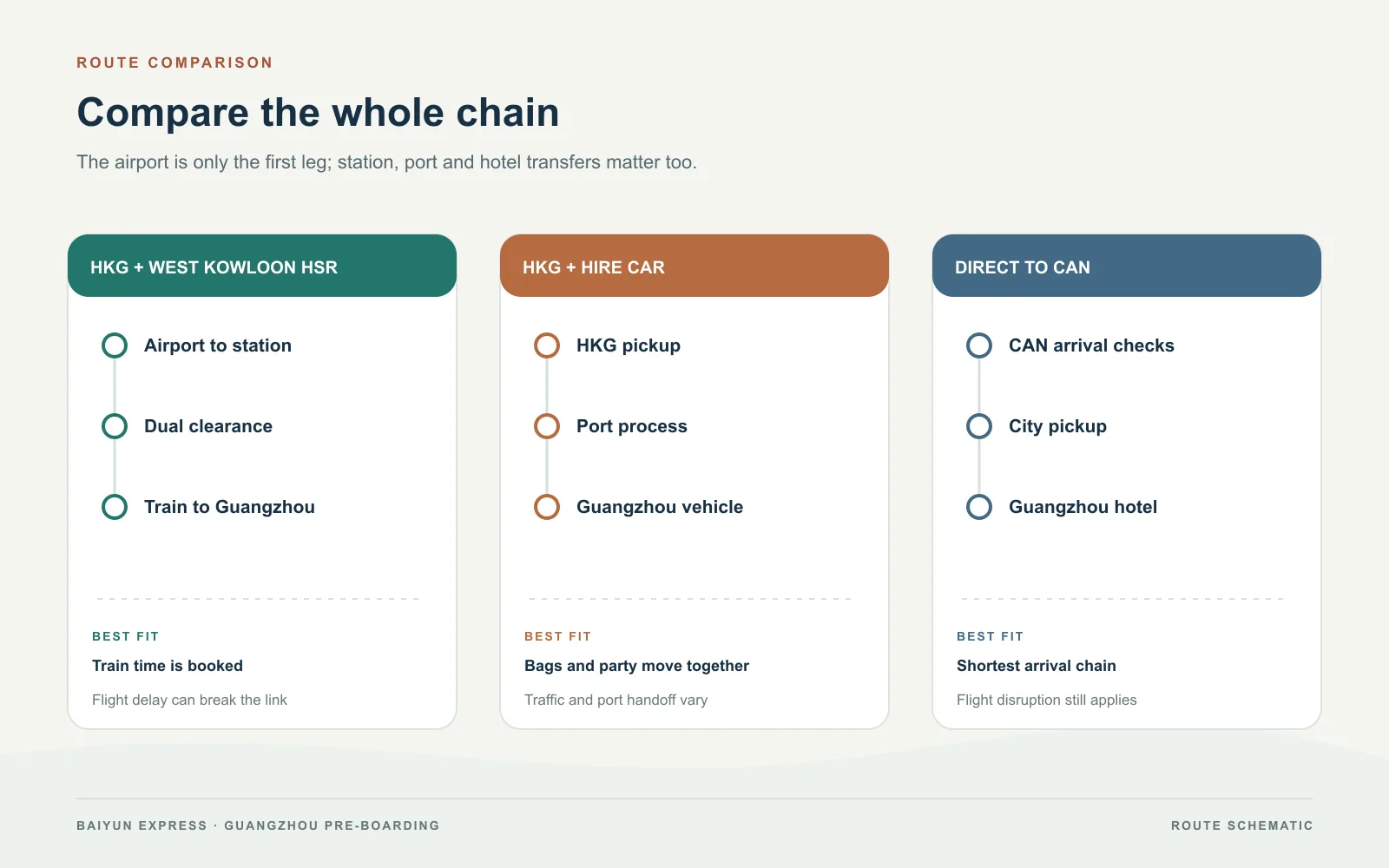
| Planning point | HKG + West Kowloon HSR | HKG + cross-boundary hire car | Direct CAN arrival |
|---|---|---|---|
| Main sequence | HKG to West Kowloon, station formalities, train, Guangzhou last mile | HKG pickup, authorised vehicle, land-port clearance, Guangzhou hotel | CAN arrival procedures, baggage, city transfer, Guangzhou hotel |
| Border step | Hong Kong and Mainland immigration at West Kowloon before boarding | Passenger clearance at the selected land port; follow official instructions | Mainland entry procedures at CAN |
| Best fit | A published train time suits the flight and the group can manage a station transfer | A written vehicle plan fits the group, bags and port process | A direct flight and uncomplicated Guangzhou transfer suit the itinerary |
| Confirm in writing | Train time, station-to-hotel transfer, baggage rules and delay plan | Hire-car authorisation, port, same-vehicle plan, baggage and waiting terms | Arrival meeting point, vehicle, hotel and delay arrangements |
| Main risk | Missed train after a late flight or slow airport-to-station transfer | Road traffic, port queues or a passenger / vehicle handoff | Flight disruption or a late arrival before the planned hotel check-in |
HKG to Guangzhou by High-Speed Rail from West Kowloon
The rail plan is a sequence of two journeys, not one airport-to-train connection. First travel from Hong Kong International Airport to Hong Kong West Kowloon Station. Then board a cross-boundary high-speed train for a Mainland station serving Guangzhou. Check the exact destination shown on the ticket and where it sits relative to your hotel; Guangzhou South is not the same place as the city-centre hotel district or the Baiyun Express reporting point.
Buy the rail ticket only after checking the flight arrival time, the route from HKG to West Kowloon, the station's current procedures and the consequences of a late inbound flight. Cross-boundary tickets are tied to passenger identity information. The document used for the real-name check must match the valid document associated with the ticket. Do not assume a screenshot, a changed passport or a train ticket bought for one passenger can be transferred to another.
At West Kowloon, allow time for ticket and identity checks, baggage security, Hong Kong and Mainland immigration, and boarding. These steps happen before you enter the train. A short normal processing estimate is not a safe arrival target for every passport holder, holiday, group or departure. Follow the current MTR notice and the train ticket's cut-off time, and add margin for walking from the airport transfer arrival point through the station.
After the train reaches the Mainland, collect your bags, follow the signs and meet the pre-booked Guangzhou transfer. Confirm whether the driver waits at the station exit, whether the vehicle has a clear name board, where a party of several people can regroup and what happens if the train is late. A hotel near the Pearl River or Yuexiu district can still require a road transfer from the rail terminal.
This route works best when the inbound flight arrives with enough recovery time before a train you can afford to miss or rebook. A separate ticket gives you control over the choice of rail departure but also separates the airline and railway responsibilities. If a missed connection would disrupt the hotel or the onward train journey, spend the extra night in Hong Kong or move the flight earlier rather than building the plan around the fastest theoretical connection.
When comparing tickets, look at the station named for arrival, not only the word Guangzhou in a search result. Check whether the train terminates at Guangzhou South, Guangzhou East or another station, then ask the hotel arranger to price the correct pickup. Share the train number and a contact method that works after you cross the border. If several guests arrive together, select a rendezvous point outside the passenger flow so nobody blocks the exit while the driver searches for the group. For a party with different passports, have each traveler check the same official entry and ticket requirements individually; a lead passenger's eligibility does not settle the others'.
Treat station processing as a real transfer
MTR's current West Kowloon departure process describes real-name ticket checking, security, Hong Kong and Mainland immigration, then boarding. The ticket controls the train-specific rules and cut-off times, so check those again before travel rather than relying on an old itinerary or a transfer estimate.
Review the current West Kowloon departure process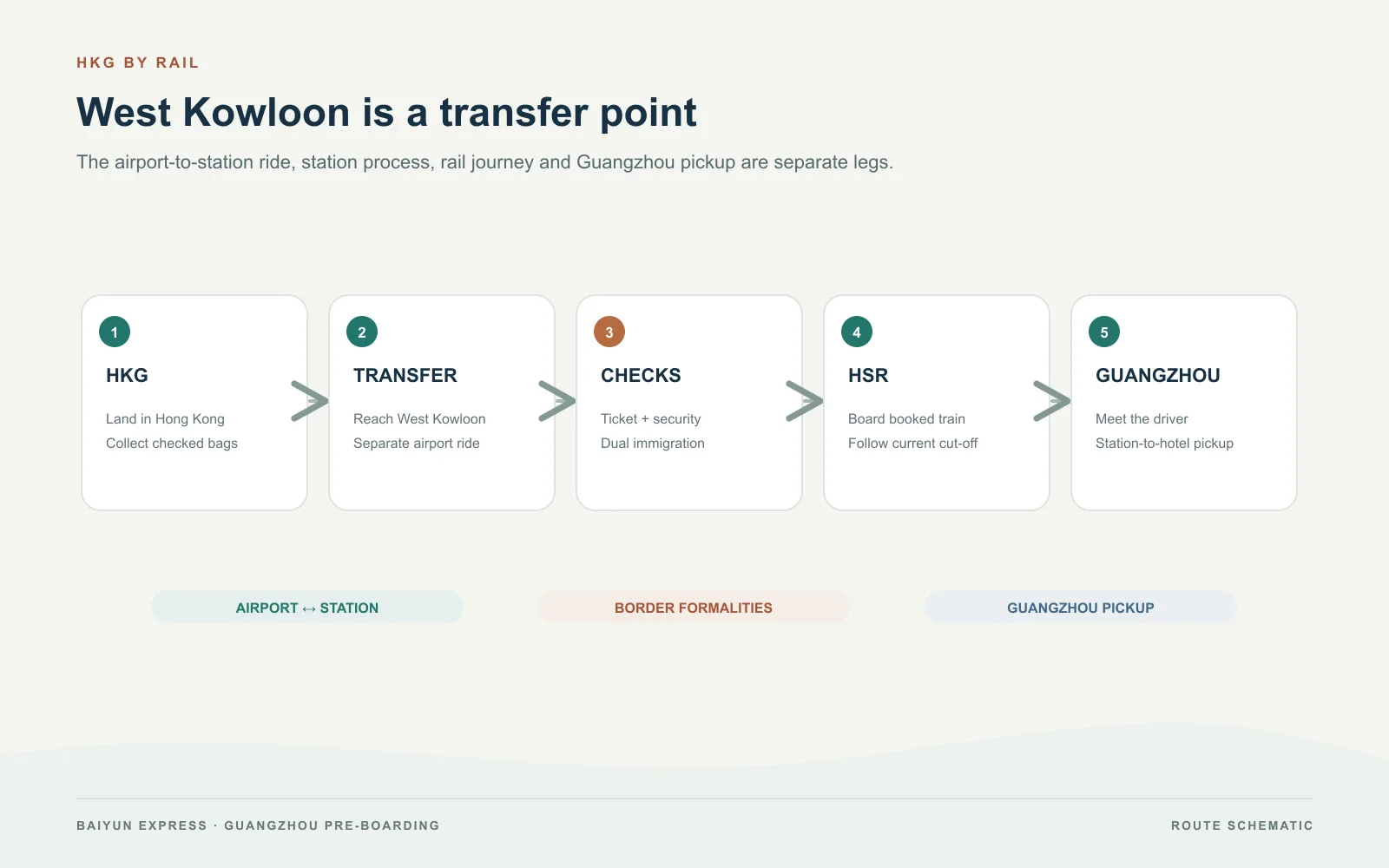
HKG to Guangzhou by Cross-Boundary Private MPV
A car or MPV transfer can fit a family, a party with several suitcases or guests who prefer a single coordinated ground booking. The useful question is not simply whether a driver can collect you at HKG. Ask whether the quoted service is authorised to carry your party for hire across the Hong Kong and Mainland boundary and which port is included in the plan.
The border is a formal passenger and vehicle control point. It is not a hotel lobby stop. Official guidance says passengers in cross-boundary vehicles generally leave the vehicle and use the passenger clearance hall while the driver and vehicle follow their own process. The exact path can vary with the port, vehicle, service type and current instructions. No operator can remove immigration or customs decisions from the authorities.
Ask the supplier to write down the port, pickup location, passenger clearance sequence, luggage handling and whether the same vehicle is expected to continue after the boundary. If a second vehicle or driver takes over, clarify where the group meets, who moves the bags and how much time is allowed. If the answer is only “private car, door to door,” request the permit or service description that shows it is a lawful cross-boundary hire-car arrangement.
A direct vehicle transfer can still be affected by congestion between HKG and the port, queueing, inspection, weather and traffic in Guangdong. A quoted journey duration is an estimate, not a guarantee. Keep food, medicine and essentials in cabin bags; retain passports and valuables with each traveler; label checked cases; and avoid placing any item in a vehicle trunk before the driver confirms where the passenger must report at the port.
This route is strongest when the operator has confirmed the service and the hotel can receive the party with flexible check-in. It may be less convenient than rail for a solo traveler with one case, or if the party needs a predictable departure window. Compare the full quote with HSR, airport transfers, station pickup and baggage assistance included. The cheapest line item may omit the second driver, port waiting, tolls or after-hours charges that determine the real handoff.
Ask for a written itinerary with the Hong Kong pickup address, planned port, passenger reporting point, Mainland meeting location and the name or contact of the person responsible at each step. Confirm whether the quoted price covers every passenger, all bags, tolls, port charges, waiting time and a late flight. A quote should also state what happens if the vehicle is delayed or a port instruction requires a different handoff. Keep the answer with your booking file and send the same plan to every adult in the group. This makes it easier to notice a missing leg before departure and gives the hotel a realistic arrival window without implying that the driver controls border processing.
Verify the vehicle service, not just the vehicle size
Hong Kong's Transport Department distinguishes a permitted cross-boundary hire car from an ordinary private car. Ask the arranger to confirm the vehicle's authority to carry passengers for hire or reward across the boundary, and have the relevant service terms written into the quotation.
Check the Transport Department's cross-boundary vehicle guidance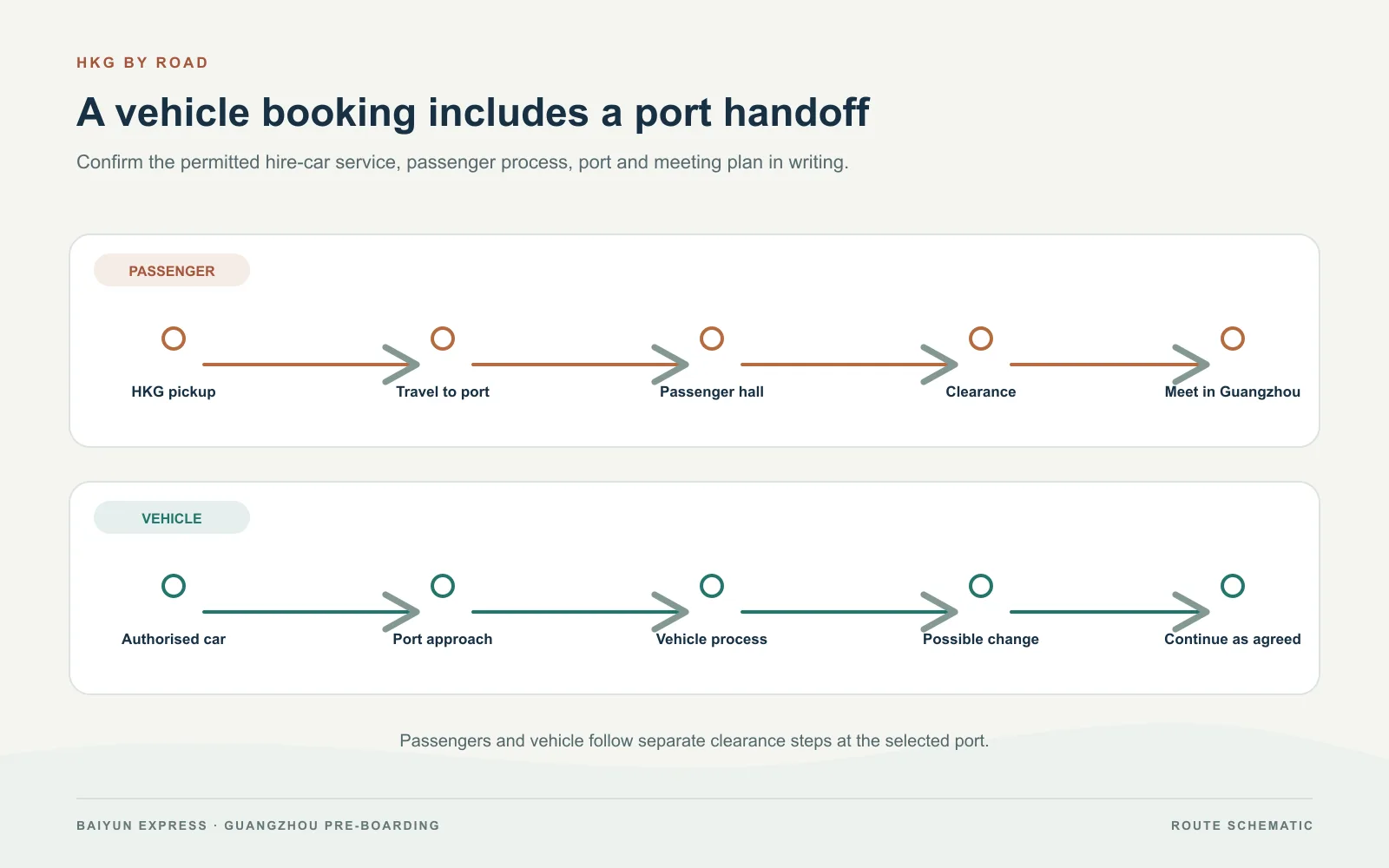
Flying Straight to Guangzhou Baiyun Airport (CAN)
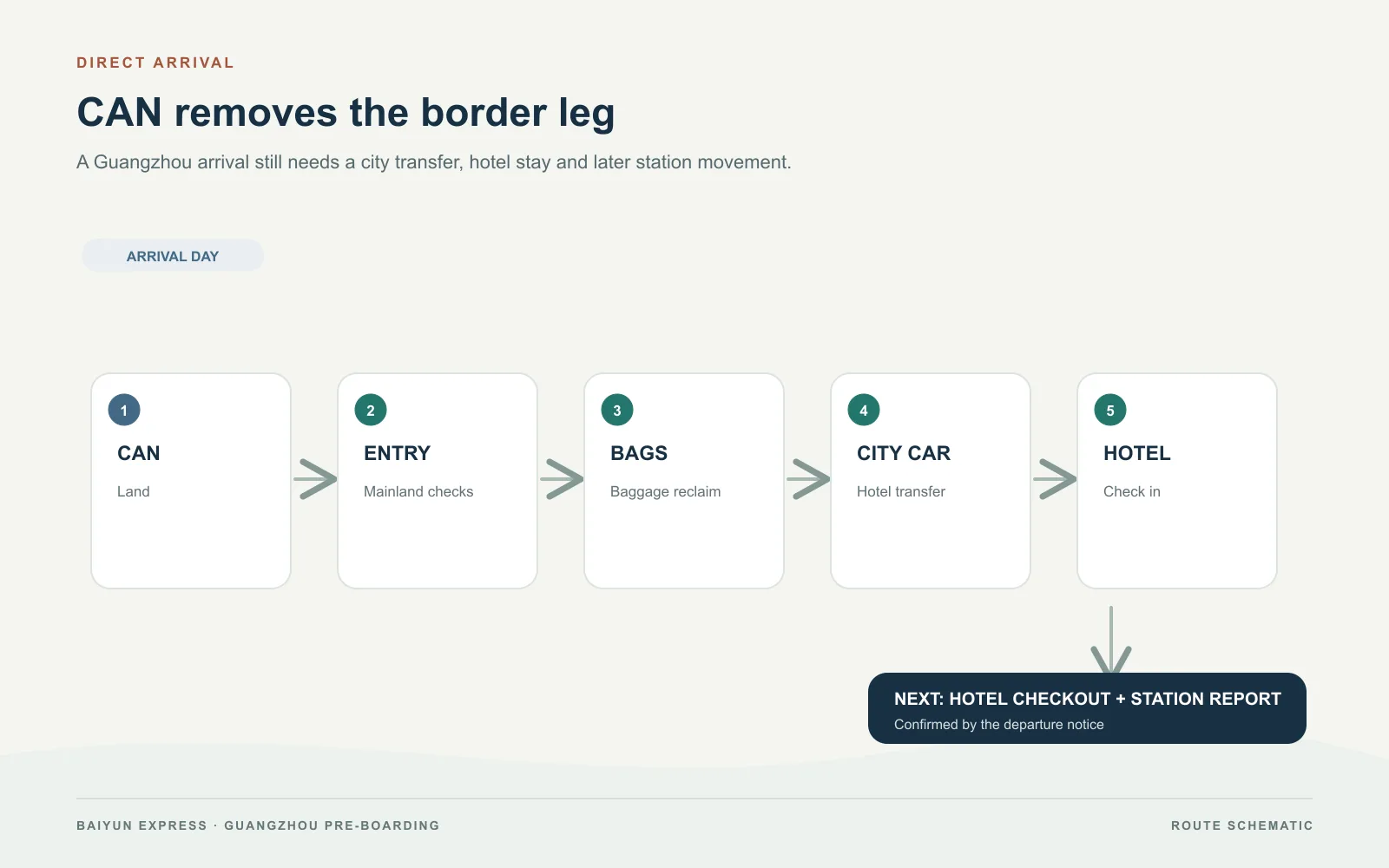
When schedules and fares work, CAN is the more direct arrival for a Guangzhou departure. You land in the same Mainland city where the pre-boarding hotel and train arrangements are being staged. There is no additional Hong Kong-to-Mainland transfer, no West Kowloon rail booking and no separate land-port vehicle crossing to coordinate.
The arrival still has its own sequence: aircraft disembarkation, entry checks, baggage reclaim, customs if required, meeting your driver and the road journey to the hotel. The driver cannot collect your group before the flight lands or move you through immigration. Confirm the meeting point by terminal and arrival hall, how long the vehicle waits, how the operator handles a delayed flight and whether a late-night supplement applies.
Choose a flight that leaves room for disruption. A non-stop route from your home city may not operate on every date; a connection through another airport can be vulnerable to a missed onward flight. Check the ticketing conditions and baggage transfer arrangement with the airline, then send the final flight number and local arrival time to the transfer arranger. If your group arrives on different flights, agree one shared hotel meeting plan instead of assuming the first driver can wait for everyone.
CAN is not the Baiyun Express station. A direct airport arrival still needs a hotel-to-station transfer on the departure date, and the station named on the final departure notice may differ from the airport or your hotel. In the quote, keep airport pickup and departure-morning station escort as distinct legs. Confirm the hotel's exact address, vehicle capacity, luggage space and the point where the train representative accepts the group.
Direct CAN is usually the simplest choice for a short pre-train visit, for a party that prefers one Mainland arrival and a hotel base, or when an HKG flight would leave little time for a second leg. It can be a poor fit if flight schedules force a risky late arrival or if ticket pricing makes a planned HKG extension more sensible. Compare the full flight itinerary, entry permission, hotel nights and transfers together, not only the first airfare.
When you request the pickup, include the airline, flight number, arrival date, terminal if known, passenger count, case count and hotel address. Ask how the driver will identify the lead passenger and where to wait if the group is split between immigration and baggage reclaim. If your international flight has a connection, verify whether checked cases are through-tagged or must be collected and checked again at the transit airport; the airline controls that answer. Keep the first hotel night flexible enough for a realistic arrival, and avoid committing the group to a timed city activity before the flight has landed. These details turn a direct arrival into a predictable handoff without treating an airport transfer as an included rail service.
Clearance, Documents and Luggage Across Two Jurisdictions
Hong Kong entry permission and Mainland China entry permission are separate questions. The passport and visa or visa-free status that let you visit Hong Kong do not, by themselves, establish that you can enter Mainland China. Check the current rules for every passport holder in your group against the complete trip, including the arrival day, the rail journey and any nights before or after it.
For a West Kowloon train, use the valid identity document tied to the ticket and keep it available for station checks. For a vehicle crossing, keep each travel document with its owner and follow port instructions for passenger clearance. Children, mixed-nationality families, name changes or passports renewed after ticket purchase need special attention. Ask the rail operator or ticket issuer how a document change is handled before travel.
A visa-free transit policy should not be treated as a substitute for trip-specific entry advice. China's 240-hour transit route is limited by nationality, port, allowed travel area and an onward itinerary to another country or region. The 18-day Baiyun Express Xinjiang loop already exceeds ten days, before adding the three-day pre-boarding stage, so the transit policy cannot cover that full plan. Other visa-free entry rules may apply to some passports; verify rather than infer.
Bag handling differs across the route. At the airport, your airline controls check-in and checked baggage. At West Kowloon, MTR publishes luggage rules and the station conducts security checks. At a land port, officials may direct passengers and bags through inspection. On arrival in Guangzhou, confirm who carries bags from the station or airport to the vehicle and from the hotel lobby to the train reporting point.
Keep a practical two-bag setup: a main case for the hotel and train cabin, plus a small day bag containing documents, medication, chargers and one change of clothes. Photograph the case tags and write the hotel address in English and Chinese. The organizer may assist with luggage, but that does not remove your responsibility to keep travel documents, valuables and any item needed during the border process with you.
Make a document check for each traveler rather than one list for the booking contact. Confirm that the name and document number supplied to the rail ticket issuer match the document you will carry, and ask what to do if a passport is renewed after purchase. Keep a paper copy of the hotel address and the two transfer contacts in case a phone loses service or battery. For checked luggage, retain the claim tag until the case is back in your possession. If a bag is delayed, report it to the airline before leaving the airport and notify the Guangzhou hotel contact, so the transfer plan can be adjusted without sending a traveler back through a restricted area.
Check visa and transit eligibility for the whole stay
The National Immigration Administration publishes the current transit-without-visa conditions, including the eligible passport list and required onward itinerary. These policies change. Confirm your own nationality, port, allowed area and maximum stay with the relevant official authority before booking non-refundable travel.
Read the National Immigration Administration's current transit policy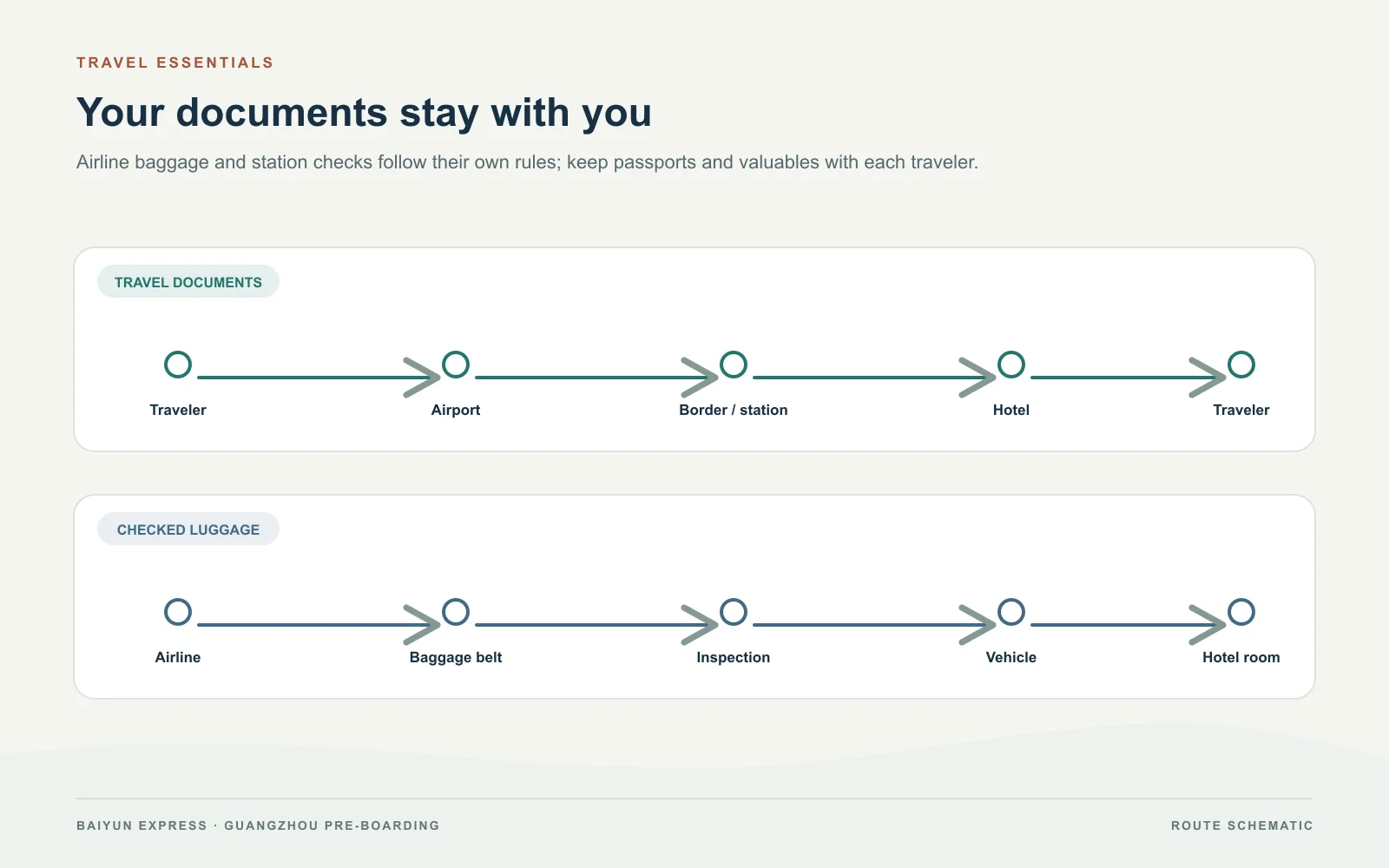
Use a Guangzhou Hotel as the Buffer
A hotel night is not spare time to fill; it is the buffer that protects an expensive, multi-day departure from an uncertain international arrival. A late flight can turn a tight connection into a missed train or force the group to reach the station tired, carrying bags and still resolving ground transport. Staying in Guangzhou before boarding moves those risks away from the station morning.
A practical pattern is to arrive two nights before boarding. The first day is for the flight, entry procedures, transfer and check-in. The next day gives the party time to rest, eat and resolve missing baggage or ticket issues. The third day is the scheduled hotel-to-station movement. This is the structure of the published 3-day, 2-night private pre-boarding extension, not a promise that every booking includes the same hotel or service.
Pick the hotel with the departure transfer in mind. Ask where the property sits relative to the confirmed reporting station, whether a large vehicle can stop at the entrance, what the luggage route is through the lobby and whether check-in will be ready for your party's arrival window. A riverfront or heritage-district hotel may enrich the stay, but the exact property and transfer plan depend on the written quote.
Use the second day for a light schedule rather than a long excursion that ends far from the hotel. If you want the Greater Bay Area visit or Lingnan heritage activities described in the program, confirm which locations, meals and vehicle time are included for your party. Keep time to repack, separate the overnight essentials, check the station notice and make sure each traveler has the correct passport and rail or train documents.
If the international flight lands only one night before departure, ask whether the planned arrival route leaves enough margin for your group. A private pickup cannot control the flight, port or customs queue. An HSR ticket cannot make an inbound plane arrive on time. The extra hotel night has a visible cost, but it can prevent a chain of missed bookings that is harder and more expensive to repair on the morning of departure.
Choose a property that works for the group, not just for the sightseeing list. Ask whether all rooms can be checked in under the booking arrangement, whether late arrival is recorded, how breakfast timing fits the station departure and whether the hotel can store luggage after checkout if the reporting time changes. Travelers arriving on different flights may benefit from one shared property and a common lobby meeting point. If the party includes children or older relatives, consider elevator access and the distance from the drop-off point to reception. These are hotel-selection questions, not claims that a particular property or accessibility feature is included in the published package.
What the published extension says
The current Guangzhou & Greater Bay Area program describes HKG or CAN arrival, two Guangzhou hotel nights and luggage-assisted station transfer on the third day. The reference private package starts from CNY 9,800 per guest. Hotel tier, party size, season, route, inclusions and travel dates affect the final written quotation.
Review the three-day pre-boarding program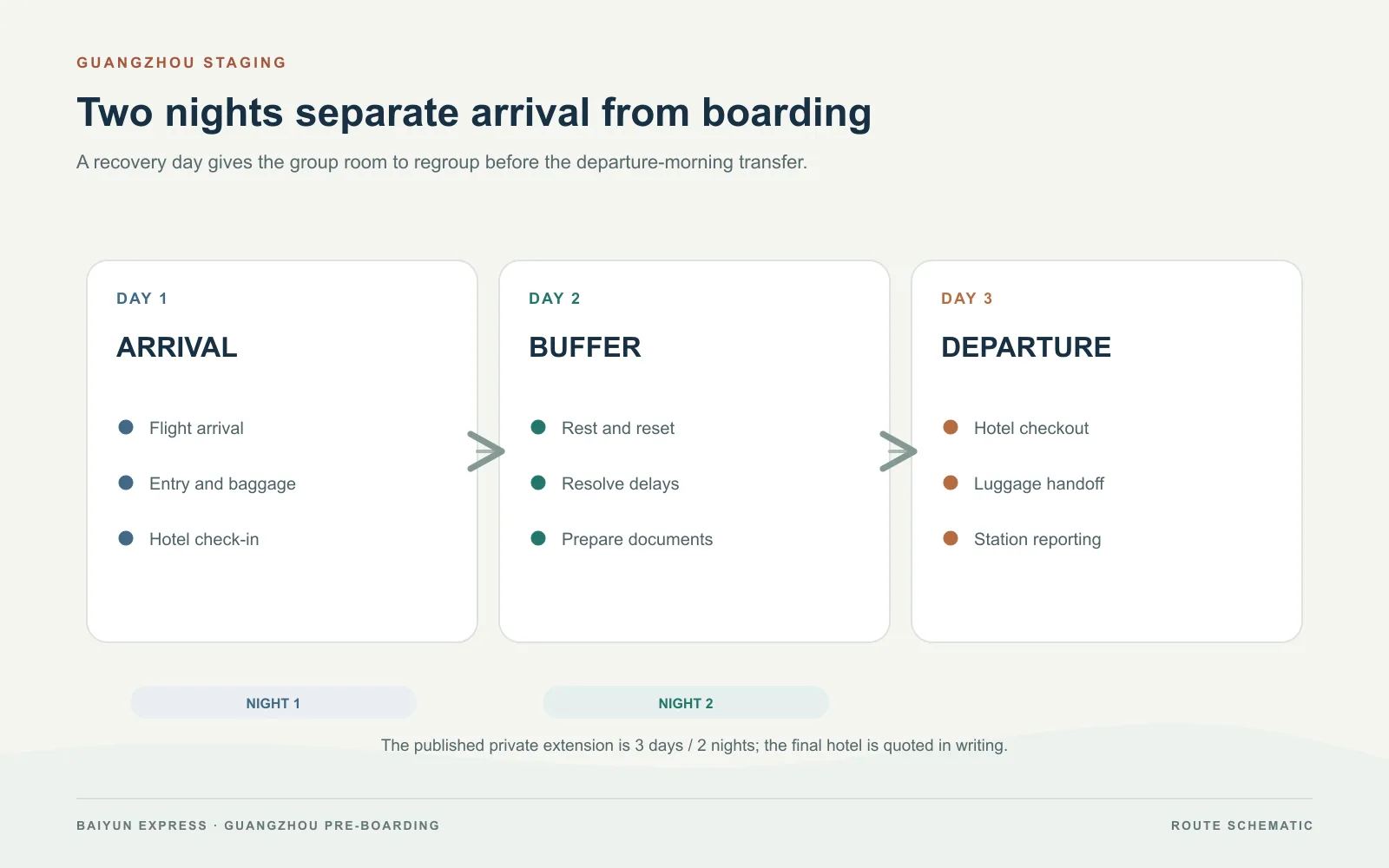
Match the Arrival Plan to the Train Product and Departure
Confirm which Baiyun Express journey you are joining before choosing flights. The 2027 Xinjiang program is an 18-day Guangzhou round trip. The separate 2026 Cloud Sanctuary program is an 11-day journey through Guangxi and Yunnan. Their dates, route, fares and booking terms are distinct; a date or price from one product should never be copied into the other.
The published Baiyun Express formation has 18 carriages and a maximum of 92 guests. It lists six Yunqi Lanyue suites of 14 m² and forty Yunqi Yayun rooms of 10.2 m². These are product specifications, not a statement that a particular cabin remains available. Ask the official booking contact to confirm the selected departure, room, occupancy and final fare in writing.
As listed on 24 November 2026, the seven 2027 Xinjiang dates are May 18, June 6, June 26, July 16, August 5, August 24 and September 14. The four dates on May 18, July 16, August 5 and August 24 are full-train government or private charter departures and are not open for individual bookings. June 6, June 26 and September 14 are listed open to individual enquiries. That status does not show how many rooms remain.
Published reference fares for the May to August dates are CNY 98,880 per guest for Yunqi Yayun and CNY 118,880 for Yunqi Lanyue. The September 14 reference fares are CNY 108,880 and CNY 128,880 respectively. Route C from Ili to Kuqa carries a CNY 6,000 per guest supplement. These amounts describe the main 18-day product; the pre-boarding extension is separate and the final fare, room, route and inclusions require written confirmation.
The 2026 Cloud Sanctuary itinerary is a separate 11-day Guangxi and Yunnan journey from CNY 59,880 per guest. It is not a shorter edition of the Xinjiang loop. Baiyun Express is operated by Panda Roam (攀达漫迹), with CTS as its strategic partner. Danny Dong Yi is the official international channel contact and an international market adviser to CTS. Use the booking page to confirm the departure-specific plan; all final details are subject to written confirmation.
Before you commit to flights, ask the booking contact to confirm the exact product name, departure date, selected room category, occupancy basis, route edition and currency in the same dated document. Request a separate line for the pre-boarding extension so its hotel and private transfer costs are not mistaken for part of the rail fare. A written quote should also identify any requested add-ons and explain which are not yet confirmed. The seven-date list and reference fares above are published planning facts; they do not guarantee that a particular room is available or that a charter date can accept individual travelers. Recheck the current booking terms before paying deposits or changing international flights.
Confirm the current departure and written terms
Before choosing flights, check the current booking page for the departure record, room request and enquiry route. Send your selected date and transfer needs for dated written confirmation; the published calendar is not a live cabin count.
Review booking details and send a written enquiry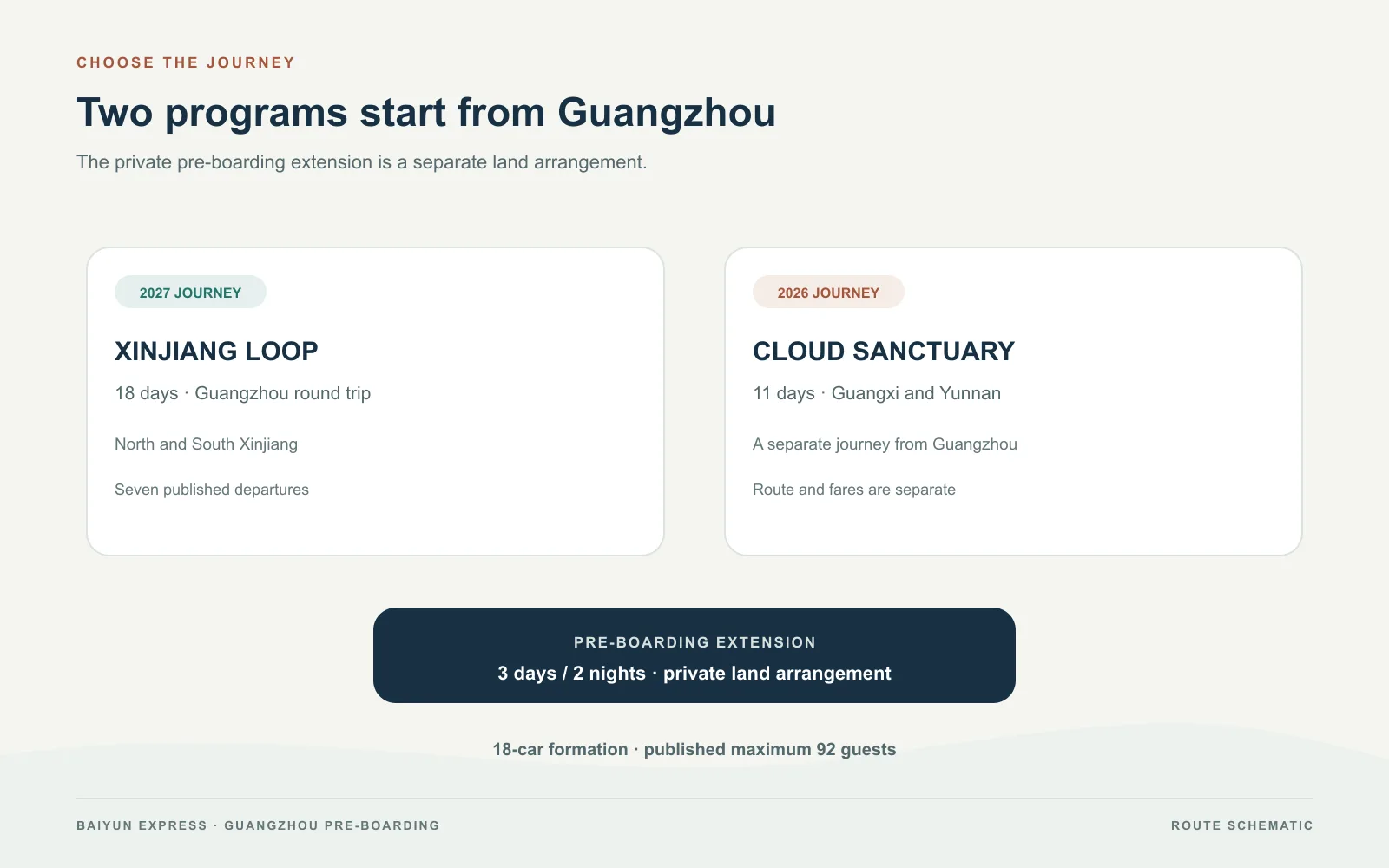
Protect the Station Handoff on Departure Morning
The final transfer begins when the hotel room is ready for checkout, not when the train reaches the platform. Follow the written departure notice for the reporting location and time. The station, entrance, identity checks and luggage process are controlled by the departure operator and railway instructions for that date. Do not substitute an old launch photograph, a generic station pin or the airport address for the current notice.
The day before, ask the hotel to confirm the checkout, breakfast timing, vehicle loading point and room-bill settlement. Put passports, medication and valuables in a bag that stays with you. Keep the larger cases closed and labeled. Give the driver one lead passenger's phone number, the hotel address and the designated reporting point in a form that works offline as well as online.
Before leaving the lobby, count people and bags. Tell the escort if a suitcase is missing, a traveler is delayed or a document has changed. A luggage-assisted transfer can reduce carrying between the hotel and station, but confirm which team handles the case after arrival and how the passenger group remains together. Do not assume that a tag, photograph or verbal handoff replaces the rail operator's passenger and baggage checks.
At the station, allow the buffer stated in the departure notice. Keep the group together while the representative verifies names, documents and luggage. If you arrive in Hong Kong and take West Kowloon rail that day, plan to spend that night in Guangzhou before the Baiyun Express boarding date; do not go directly from the Guangzhou rail station to train reporting. Keep the last-mile pickup separate from the station reporting transfer. If the itinerary uses a direct CAN arrival days earlier, keep the departure-morning transfer as a separate booking and reconfirm it after the flight.
The train is operated by Panda Roam, and CTS is its strategic partner for the international market. Danny Dong Yi is the named international contact for questions about dates, rooms, written quotations and the pre-boarding extension. Email 20000dongyi@gmail.com or contact him on WhatsApp at +86 189 8092 6126. Ask for the airport, hotel, port or rail details that matter to your party in writing, and rely on that dated confirmation for the final movement plan.
Keep the final plan compact enough to use on the day: current hotel checkout time, driver and vehicle contact, luggage count, station entrance, reporting deadline and a backup number. Ask when the last confirmation will be issued and who can answer a change after office hours. If the flight or rail leg changes, send the revised arrival details to the hotel and transfer arranger as soon as the carrier confirms them. Do not infer that a reserved hotel, seat or vehicle automatically moves to another date; ask for written approval of every change and any price difference. A single verified itinerary shared with the whole party reduces the chance that travelers follow an outdated message or meet at the wrong station entrance.
Frequently Asked Questions
Is flying into CAN easier than flying into HKG before Baiyun Express?
Usually, when a suitable flight is available, CAN is simpler because it removes the Hong Kong-to-Mainland transfer. You still need Mainland entry procedures, baggage collection, a hotel transfer and a separate hotel-to-station plan. Compare the complete itinerary rather than airfare alone.
Can I fly to HKG and take high-speed rail to Guangzhou?
Yes, if a suitable West Kowloon train is available for your date and you have enough time to reach the station and complete the required checks. The airport-to-station leg and Guangzhou station-to-hotel leg are separate transfers. Confirm the current rail ticket, identity and baggage rules.
Will a cross-boundary MPV take the same passengers and bags all the way to Guangzhou?
Do not assume so. Passengers generally leave the vehicle for clearance at the boundary, and the vehicle or driver may change. Ask for the authorised hire-car service, port, luggage procedure, same-vehicle plan, waiting terms and meeting point in the written quote.
How many nights should I stay in Guangzhou before boarding?
The published private pre-boarding extension is three days and two nights. That allows an arrival day, a recovery and preparation day, and a planned transfer on departure day. The exact hotel and included services depend on the selected dates and written quotation.
Is the three-day pre-boarding extension included in the train fare?
No. It is a separate private land arrangement. Its published reference rate starts from CNY 9,800 per guest, while the exact hotel, party size, transport, meals and dates determine the written quote. The 2027 train fares cover the separate 18-day Xinjiang program.
Can a 240-hour visa-free transit stay cover the 18-day Xinjiang loop?
No. The 18-day loop exceeds the ten-day 240-hour maximum, before any pre-boarding nights. The transit policy also depends on passport eligibility, port, permitted area and onward travel to another country or region. Check current entry rules for every traveler.
Are any 2027 Xinjiang departures open for individual enquiries?
As listed on 24 November 2026, June 6, June 26 and September 14 are open to individual enquiries. May 18, July 16, August 5 and August 24 are full-train charters. This is not a room count or guaranteed inventory; confirm status in writing.
Who confirms the hotel, transfer and final boarding instructions?
Danny Dong Yi is the official international contact for written enquiries. Use the booking page, email 20000dongyi@gmail.com or WhatsApp +86 189 8092 6126. Confirm the selected journey, flight, hotel, transfer, reporting point and all final details in a dated written quotation or departure notice.